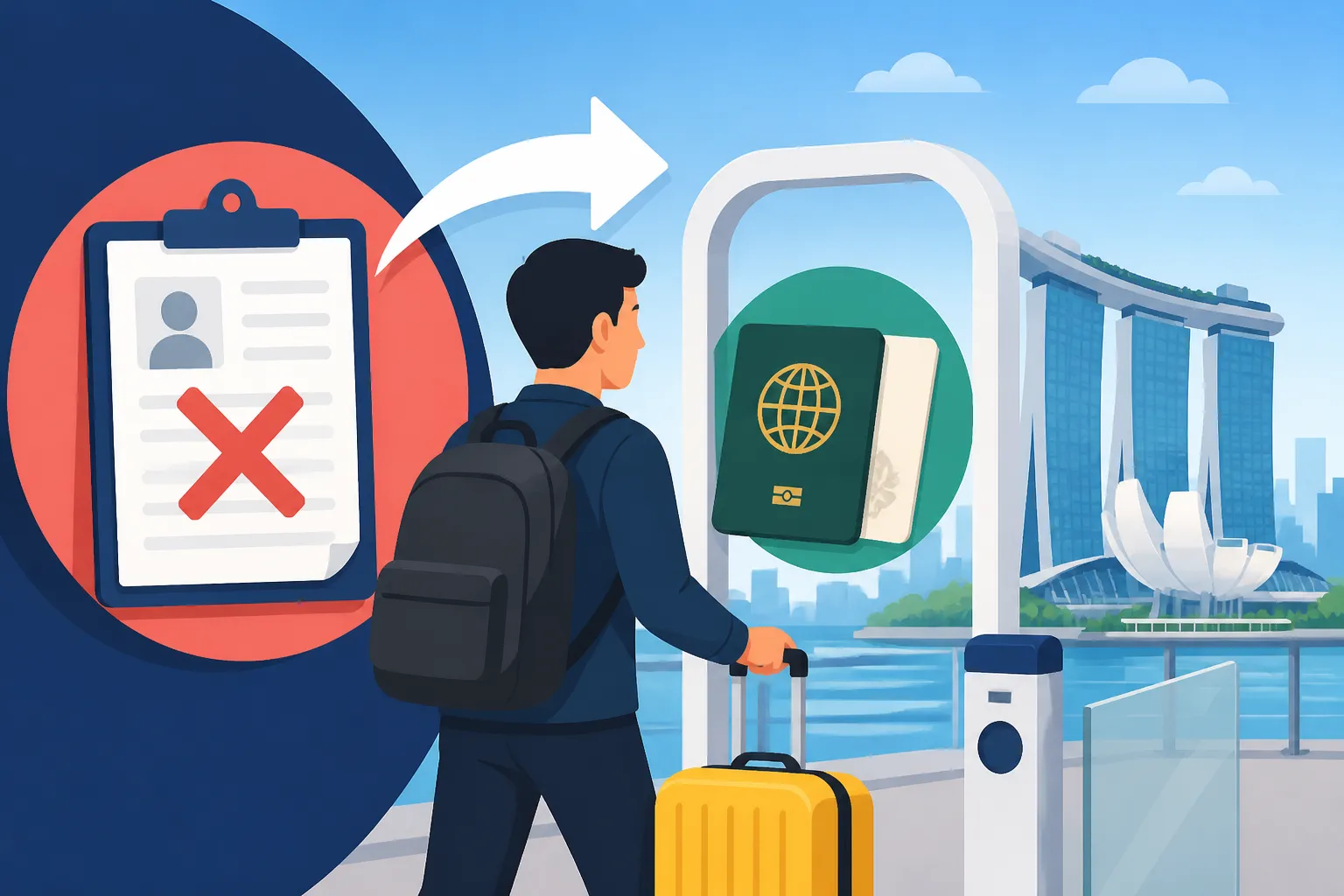
Re-entering Singapore on a Tourist Visa Shortly After Canceling an EP
Oh, the classic expat conundrum! You've navigated the whirlwind of working in Singapore, perhaps you've even had your Employment Pass (EP) cancelled, and now you're packing up your life. But then, it hits you – there are still friends to say goodbye to, a few last hawker meals to savor, or perhaps some final logistical loose ends to tie up. The idea of just popping back in on a tourist visa seems appealing, but trust me, the Immigration and Checkpoints Authority (ICA) sees things a little differently than your average tourist. This guide is going to walk you through the realistic expectations, potential pitfalls, and best practices if you're considering re-entering Singapore on a Short-Term Visit Pass (STVP) shortly after your EP has been cancelled.
The Grace Period and the 'Cooling-Off' Reality
When your Employment Pass (EP) is officially cancelled, the Ministry of Manpower (MOM) usually grants you a Short-Term Visit Pass (STVP), often valid for 30 days. This is Singapore's way of giving you a little breathing room to manage your departure. It's meant for winding down your affairs, clearing out your apartment, selling furniture, and making your final arrangements to leave the country. It’s a courtesy, not an invitation to immediately switch hats and become a tourist right after your work stint ends.
The 30-Day Short-Term Visit Pass After EP Cancellation
That initial 30-day STVP is a critical period. Many expats mistakenly view it as a free pass to extend their stay indefinitely or to seamlessly transition into a vacation. However, its primary purpose is explicitly for exit. You’re expected to use this time to finalize your departure, not to start a new chapter as a tourist without a proper long-term pass. If you're still in Singapore when your EP is cancelled, the employer is generally responsible for ensuring you get this STVP. It’s a pragmatic measure to avoid immediate overstaying.
The problem arises when individuals complete their "exit" within this 30-day window, leave Singapore for a day or two (perhaps to Johor Bahru for a quick "visa run"), and then attempt to re-enter, hoping for a fresh 30 or 90-day tourist visa. The ICA is very aware of this tactic. They keep detailed records of your entry and exit history, including your previous work pass status. The expectation is that once your EP is cancelled, your intention is to leave Singapore, at least for a substantial period, unless you have a new, approved long-term pass lined up.
ICA's Stance on Quick Turnarounds
Singapore's immigration authorities are notoriously efficient and vigilant. They have a sophisticated system that tracks individuals' entry and exit patterns. If you've just had your EP cancelled and then attempt to re-enter as a tourist very soon after, it raises a significant red flag. They're not just looking at your passport; they're looking at your entire immigration history with Singapore. The system is designed to prevent people from circumventing official visa requirements or from attempting to live and work in the country permanently under the guise of frequent tourist visits.
The underlying concern for ICA is often whether you're genuinely entering for short-term tourism, or if you're trying to re-establish a presence in Singapore without the appropriate visa. This could be to look for a new job, continue working remotely, or simply extend your stay without going through the proper channels for a long-term pass. They will scrutinize your intentions. This isn't about being punitive; it's about maintaining strict control over immigration, which is a cornerstone of Singapore's social and economic stability.
Understanding ICA's Scrutiny for Repeat Entries
You might feel perfectly justified wanting to pop back in. Maybe your flight home was cheaper a week after your STVP expired, or perhaps you just genuinely missed your friends and wanted to say a proper farewell. Unfortunately, what feels reasonable to you might look suspicious to an immigration officer who sees countless cases of individuals trying to bend the rules. This is where understanding their perspective becomes crucial.
Factors ICA Officers Consider
When you present yourself at immigration, especially if your EP was recently cancelled, officers have several data points at their disposal. They are trained to assess your intent quickly and effectively. Here are some key factors they will likely consider:
- Your Previous Immigration History: The fact that your EP was just cancelled is front and center. They'll know the reason for cancellation (e.g., resignation, termination, end of contract). This history immediately flags your profile for closer examination.
- Frequency and Duration of Previous Short-Term Visits: If you've been doing "visa runs" during your EP period, or if you've entered and exited frequently on an STVP before, this will further heighten their suspicion. They're looking for patterns that suggest you're trying to use short-term passes as a de facto long-term residency.
- Ties to Singapore: Do you have family members still residing here on long-term passes? Were you in a relationship with a local or a Permanent Resident? While these might be genuine reasons for a visit, they can also be seen as incentives to overstay or seek informal employment.
- Financial Means: Can you genuinely afford a tourist visit? Do you have sufficient funds to cover your accommodation, food, and activities without working? This is where showing evidence of financial stability becomes important. Services like Wise can be helpful here, as they allow you to manage funds across currencies, providing clear statements that might demonstrate your ability to cover expenses without local income.
- Evidence of Outward Journey: Do you have a confirmed return or onward ticket out of Singapore? This is almost always a non-negotiable requirement for any tourist visa. A one-way ticket is a major red flag, suggesting you have no firm plans to leave.
Avoiding Red Flags at Immigration
The best way to navigate this situation is with complete honesty and transparency. ICA officers are not easily fooled, and attempting to hide information or fabricate stories will almost certainly lead to a negative outcome.
- Be Prepared for Questions: Expect to be asked "Why are you back so soon?" or "What is the purpose of your visit?" Have clear, concise, and truthful answers ready.
- Have a Concrete Itinerary: Don't just say you're "visiting friends." Have actual plans: "I'm meeting friends for dinner on Tuesday, visiting Gardens by the Bay on Wednesday, and flying out Friday morning." Show that your visit has a defined end and tourist activities. This is particularly important for those who have a history of having their EP cancelled. You can learn more about What to Say to ICA Officers During Secondary Questioning at the Airport.
- Prove Your Genuine Tourist Intent: If you're coming back for a week to attend a friend's wedding, have the invitation. If it's to see a specific attraction, mention it. The more genuine and specific your stated purpose, the better. Your past status as an expat can lend credence to a desire for a short, sentimental farewell tour.
- Do Not Attempt to Work: This should go without saying, but under no circumstances should you attempt to undertake any form of paid or unpaid work while on a tourist visa. This includes informal gigs, consulting, or even actively looking for a job by attending interviews without a proper pass. This is illegal and carries severe penalties, including fines, imprisonment, and caning, and will permanently jeopardize any future chances of obtaining a long-term pass. Remember that you cannot Search for a Job in Singapore on a Tourist Visa.
Practical Steps and Documentation for Re-Entry
Preparing properly can significantly ease your re-entry experience. Don't assume anything; gather all necessary documents and anticipate potential questions.
Essential Documents to Prepare
Having your paperwork in order is paramount. Think of it as demonstrating your good faith and legitimate intentions to the ICA. Here's a checklist of what you should definitely have:
- Valid Passport: Of course, ensure your passport has at least six months' validity from your intended date of departure from Singapore.
- SG Arrival Card (SGAC): This is mandatory for all travelers, including Singapore citizens and residents. You must submit it within three days before your arrival. You can learn more about SG Arrival Card (SGAC): Why You Must Submit It 3 Days Before Flying.
- Return or Onward Ticket: This is non-negotiable. You must be able to prove that you intend to leave Singapore. A flight out of Singapore to another country within the validity of your tourist visa is crucial.
- Proof of Accommodation: A confirmed hotel booking or a letter from friends/family inviting you to stay with them, including their address and contact details, is advisable.
- Proof of Sufficient Funds: Bank statements (from your home country or a multi-currency account like Wise) showing you have enough money to cover your entire stay without working are vital. Don't show up with just a few dollars in your pocket. Singapore is expensive, and ICA officers know this.
- Previous EP Cancellation Letter: Having this document, usually provided by your former employer or MOM, can actually be helpful. It demonstrates transparency and confirms the official end of your work pass status. It prevents the officer from thinking you're trying to hide something.
- Detailed Itinerary: As mentioned, a clear plan for your visit can go a long way. Think specific dates, places, and activities.
- Travel Insurance: While not strictly required for entry, it's always a good idea to have comprehensive travel insurance. This shows responsibility and that you won't become a burden on the Singapore healthcare system should something unforeseen happen. You can check out our Expat Health Checklist for the First 30 Days in Singapore for more ideas on health preparedness.
Navigating the Immigration Interview
If you're pulled aside for secondary questioning, remain calm, polite, and cooperative. This is not an interrogation designed to trip you up, but rather an opportunity for the officer to clarify your intentions.
- Be Honest and Direct: Don't waffle or provide vague answers. Answer questions truthfully and to the point. If they ask about your previous EP, simply state it was cancelled because you resigned or your contract ended.
- Explain Your Genuine Tourist Intent: Reiterate your specific, short-term plans. "I've come back for a few days to visit friends I made while living here, see the new exhibition at the ArtScience Museum, and then fly back to [home country] on [date]."
- Show Proof: If you claim to be visiting friends, have their contact details. If you're attending an event, have the ticket or invitation. The more verifiable your story, the better.
- Do Not Lie or Conceal: Fabricating a story or withholding information will be detrimental. ICA officers are highly skilled at detecting inconsistencies, and the consequences for misrepresentation can be severe. Remember, they have access to your full immigration record.
Alternative Paths and Long-Term Considerations
While re-entering on a tourist visa might seem like a quick fix for a short visit, it's not a solution for everyone, especially if your intentions lean towards anything beyond genuine, short-term tourism. Understanding when this path is suitable and when it isn't, as well as considering your long-term goals, is crucial.
When a Tourist Visa Might Not Be Suitable
The tourist visa, or STVP, is explicitly for tourism. If your purpose is anything else, you could be setting yourself up for disappointment or even serious trouble.
- Job Hunting: If you are coming back to look for a new job, a tourist visa is absolutely the wrong route. You cannot actively seek employment on an STVP. While you might be able to have casual conversations, attending formal interviews could be seen as a violation. If you are serious about returning to work in Singapore, you need to apply for a new Employment Pass (or other relevant work pass) from outside the country. Your prospective employer would initiate this process. Attempting to Reapply for PR After a Rejection or a new EP might be hindered by previous immigration issues.
- Extended Stays: If your desired "visit" extends beyond a few weeks and you don't have a new long-term pass, you should reconsider. Applying for an extension of your STVP is possible through the ICA e-Service E-Xtend, but it's not guaranteed, especially if you've recently cancelled an EP. Extensions are usually granted for compelling reasons like medical emergencies or flight disruptions, not for extended leisure. Repeated extensions or attempts to stay for long periods will definitely flag you.
- Bringing Belongings: If you're primarily re-entering to collect a significant amount of belongings you couldn't move during your initial exit, this might be viewed with less suspicion if you have a clear plan and departure ticket. However, if this is part of a larger, ongoing move, you might need to coordinate with international moving companies like Sirelo to ensure proper customs clearance and efficient logistics, reducing the need for multiple short visits to sort things out yourself.
Future Immigration Plans
Every interaction with ICA contributes to your immigration record. How you conduct yourself during re-entry on a tourist visa after an EP cancellation can have lasting implications, particularly if you envision returning to Singapore for work or residency in the future.
- Impact on Future EP Applications: If ICA perceives that you attempted to circumvent immigration rules or misused your short-term visit pass, it could negatively impact any future Employment Pass applications. Employers often use the MOM's self-assessment tool, but ICA has the final say. A history of being denied entry or having visas cancelled due to non-compliance can make it much harder to get approval. It's important to keep your immigration record clean.
- Permanent Residency (PR) Applications: Similarly, if you ever plan to apply for Permanent Residency (PR) in Singapore: Paths, Points, and Processes, your entire immigration history will be reviewed. Any blemishes related to visa overstaying or misuse can be a significant barrier.
- The Big Picture: Singapore takes its immigration policies very seriously. While the system can feel rigid at times, it's designed for clarity and security. Your best bet is always to operate within the defined rules, be honest, and if in doubt, seek official clarification from the ICA rather than making assumptions. Understanding the broader Singapore Visa and Immigration: The Complete Guide for Expats (2027) is always a good idea for any long-term expat.
Here's a quick comparison of what makes for a smooth re-entry vs. what might raise eyebrows:
| Aspect | Genuine Tourist Intent (Lower Risk) | Potential Red Flags (Higher Risk) |
|---|---|---|
| Time Since EP Cancel | Several weeks or months have passed since your initial departure. | You left Singapore immediately after EP cancellation (within a few days) and are trying to re-enter almost immediately. |
| Purpose of Visit | Specific, short-term tourist activities (e.g., attending an event, visiting specific attractions, farewells). | Vague reasons ("just to hang out," "don't know yet"), or implicitly for job searching (attending interviews), or completing business activities. |
| Duration of Stay | A clearly defined short period (e.g., 3-7 days), aligning with your stated tourist activities. | Requesting a long duration (e.g., 30+ days) without a clear, compelling reason, especially if your prior visit was also short and directly after EP cancellation. |
| Proof of Funds | Ample funds in your bank account (e.g., Wise, home country bank) to cover all expenses without working. | Limited funds, reliance on local friends/family for all expenses, or inability to demonstrate financial solvency for your trip. |
| Outward Journey | Confirmed flight ticket out of Singapore to your home country or another destination within your visit limit. | One-way ticket, no confirmed onward travel, or an onward ticket to a nearby country with the intention of re-entering Singapore soon after. |
| Honesty with ICA | Transparently disclosing previous EP status and answering questions truthfully and calmly. | Attempting to hide previous EP cancellation, giving evasive answers, or becoming agitated during questioning. |
| Behaviour | Relaxed, prepared, with a clear plan. | Appears nervous, provides inconsistent information, or shows signs of trying to avoid scrutiny. |
Ultimately, Singapore is a welcoming country for genuine tourists, but its immigration rules are firm and consistently enforced. If you're thinking of re-entering on a tourist visa shortly after your EP cancellation, proceed with caution, honesty, and thorough preparation.
Disclaimer
The information provided in this guide is for general informational purposes only and does not constitute legal or immigration advice. Singapore's immigration policies and regulations can change, and individual circumstances vary greatly. It is always recommended to consult the official ICA (Immigration & Checkpoints Authority) website or seek professional advice from an immigration consultant for the most accurate and up-to-date information pertaining to your specific situation.


