Can I Open a Singapore Bank Account Before I Arrive with an In-Principle Approval (IPA)?
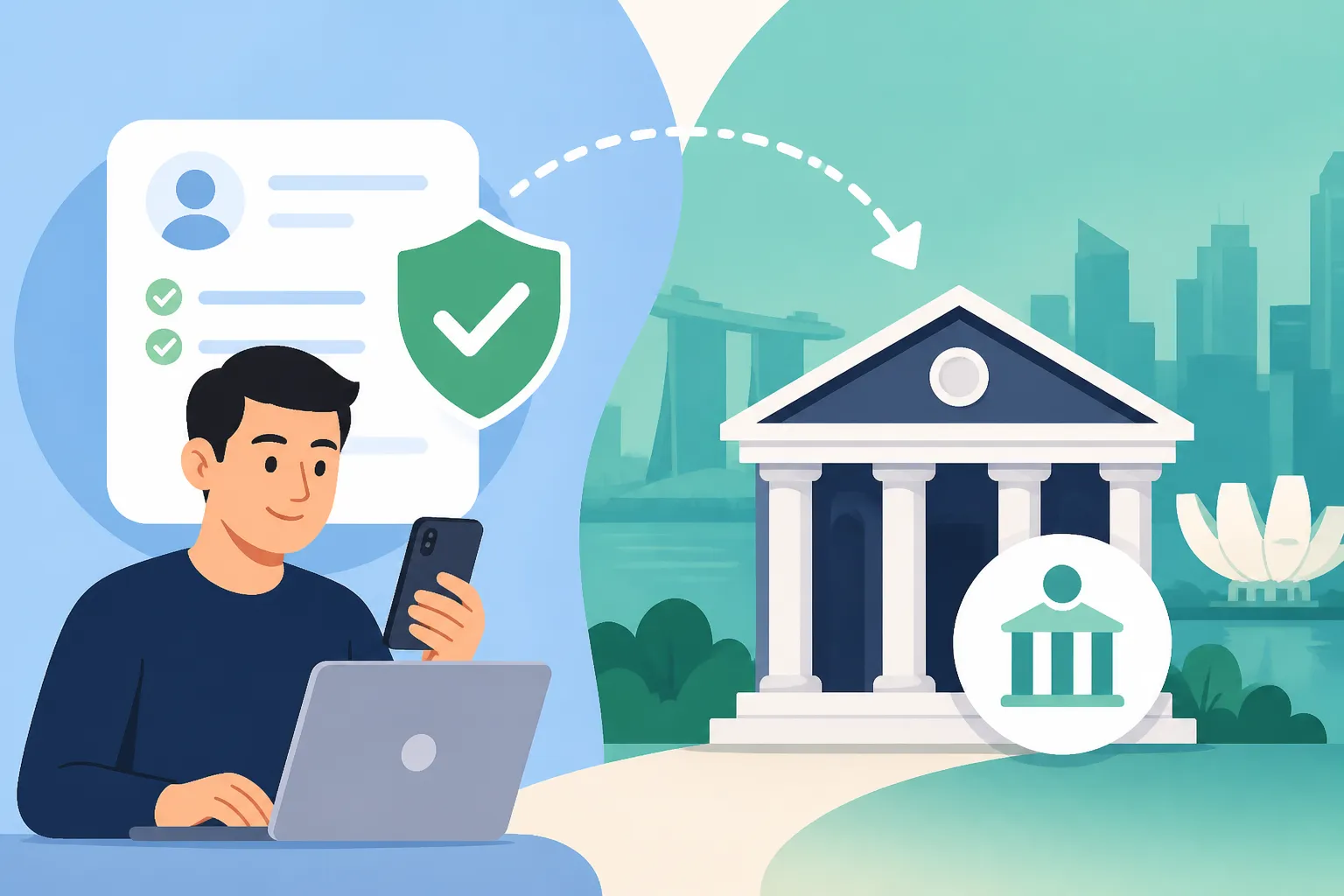
The stress of a move to Singapore often hits its peak when you realize you are caught in a financial "no-man’s land": you have your job offer and your In-Principle Approval (IPA) letter, but you cannot easily pay your security deposit or secure a rental without a local bank account. This guide breaks down exactly whether you can bridge that gap from abroad and how to navigate the strict compliance landscape of the Singaporean banking system.
The Challenges of the In-Principle Approval (IPA) for Banking
The In-Principle Approval (IPA) letter is a significant milestone in your relocation journey. It is the document issued by the Ministry of Manpower (MOM) once your Employment Pass or S Pass application has been pre-approved. While this letter feels like a golden ticket, it is important to understand its limitations within the banking sector. To a bank, an IPA is a statement of intent, not a finalized legal status. Most retail banks in Singapore operate under strict "Know Your Customer" (KYC) and anti-money laundering (AML) frameworks mandated by the Monetary Authority of Singapore (MAS). These frameworks typically require a finalized, issued work pass or a physical presence for identity verification before a full-service account can be activated.
I remember the frustration of sitting in my home country, IPA in hand, trying to explain to a local banker over the phone that I needed to transfer my relocation allowance immediately. The reality is that while your IPA contains your Foreign Identification Number (FIN), the pass itself is not "issued" until you physically arrive in Singapore, complete your Medical Checkup for EP Application: X-Rays and Blood Tests Explained, and have your notification letter generated. Because the IPA can technically be withdrawn or may expire if you fail the medical exam, banks view it as a high-risk document for account opening.
Furthermore, the banking systems in Singapore are increasingly tied to the Singpass ecosystem. Singpass is the national digital identity, and you cannot register for it until your work pass is fully issued and your biometrics are captured at the MOM services center. Without Singpass, the seamless "three-minute" account opening apps you see advertised are essentially off-limits to you. You are instead relegated to the manual application path, which almost always requires a face-to-face meeting at a branch or a very specific set of notarized documents from overseas.
If you are currently looking at Initial Rental Costs: Security Deposits, Stamp Duty, and Advance Rent, you might be panicking about how to send thousands of dollars to a landlord without a local account. In this stage, your IPA serves as proof of your future residency, which can help in conversations with landlords, but it rarely moves the needle with the compliance department of a local bank like DBS or OCBC until you have a local residential address and a stamp-duty-paid tenancy agreement.
Exploring Remote Account Opening Pathways
Despite the hurdles, it is not entirely impossible to begin your financial setup before you touch down at Changi Airport. However, you need to choose the right channel. If you are a high-net-worth individual or have an existing relationship with a global bank like HSBC, Citibank, or Standard Chartered, you may be able to use their "International Banking" or "Premier" services. These banks can often leverage your credit history and identity verification from your home country branch to open a Singapore-based account. The caveat here is that these accounts often require a high minimum balance, sometimes upwards of S$200,000, to waive monthly fees.
For the average expat who does not want to park a fortune just to get a debit card, the most realistic path involves using multi-currency platforms. This is where a service like Wise becomes an essential tool in your pre-arrival kit. Unlike traditional banks, Wise allows you to open a balance in Singapore Dollars (SGD) and provides you with local bank details, including a bank code and account number, even while you are still overseas. This allows you to receive your first salary or relocation reimbursement and pay for initial expenses like your temporary housing or utility deposits before you have even cleared immigration.
Another emerging option is the use of digital-only banks. While Digital Banks in Singapore: Trust Bank, GXS, and MariBank Features have revolutionized the local market, their onboarding for foreigners is still heavily reliant on Singpass. If you are an expat from a specific list of countries, some digital banks are starting to allow manual passport uploads, but the success rate is much higher once you are physically in the country and have a local mobile number. Without that +65 SIM card, even receiving the OTP (One-Time Password) to start the application can be an insurmountable barrier.
It is also worth noting that even if you manage to "open" an account remotely with a traditional bank, it is often "frozen" for outward transfers until you present yourself at a branch with your original passport and IPA letter. This "view-only" status is a common frustration for newcomers. You can see your money sitting there, but you can't use it to pay the mover or the landlord. This is why having a secondary, flexible account like Wise is so critical for those first 14 days of your transition.
Comparing Financial Onboarding Options for New Arrivals
| Method | Remote Opening Possible? | Requirements | Best For |
|---|---|---|---|
| Local Banks (DBS/UOB/OCBC) | Very Rare | IPA, Passport, Proof of Address (hard to get from abroad). | Long-term savings and local ecosystem integration. |
| International Banks (HSBC/Citi) | Yes (for existing clients) | High minimum balance, notarized docs. | High-net-worth individuals with global accounts. |
| Multi-currency (Wise) | Yes | Passport and proof of address in your current country. | Paying rental deposits and receiving first salary. |
| Digital Banks (Trust/GXS) | No (usually needs Singpass) | FIN number, Singpass, +65 Mobile Number. | Daily spending and high-interest savings once settled. |
Preparing Your Documentation While Still Overseas
If you are determined to try a manual application with a local bank using your IPA, you must prepare a specific dossier of documents. The standard Opening a Bank Account in Singapore: Required Documents for Foreigners list is strict. Beyond your passport and IPA letter, you will need "Proof of Residential Address." This is the part that trips up 90% of expats. If you haven't signed a lease yet, you don't have a Singapore address. Some banks will accept a utility bill or bank statement from your home country (not older than three months), but these often need to be translated if they are not in English.
You should also be aware of your home country’s reporting requirements. Opening an account in Singapore, even with just an IPA, can trigger tax reporting obligations. For example, US citizens must be mindful of FATCA (Foreign Account Tax Compliance Act). This is where consulting with a firm like Taxes for Expats becomes invaluable. They can help you understand the FBAR (Report of Foreign Bank and Financial Accounts) filing requirements that kick in the moment your aggregate foreign accounts exceed $10,000. It is much easier to set up your record-keeping now than to try and recreate it during tax season.
In addition to your tax planning with Taxes for Expats, you should ensure your employment contract is easily accessible. Sometimes, the bank will ask for a signed copy of the contract to verify the source of funds and your expected monthly turnover. If your employer is a well-known multinational, the process is smoother. If you are joining a small startup, the bank may conduct more rigorous due diligence on the company itself before allowing you to open an account on an IPA.
Lastly, do not underestimate the importance of a local phone number. You can actually purchase an e-SIM for Singapore before you arrive. Having a +65 number allows you to fill out bank forms accurately and ensures you can receive the necessary activation codes. Most local banks will not allow you to register an account using a foreign mobile number because of the high risk of SMS-based phishing and the technical limitations of their 2FA (Two-Factor Authentication) systems.
Transitioning from IPA to a Full Local Account
Once you land in Singapore and your EP is issued, your priority should be to convert your "temporary" financial status into a permanent one. The first step is to complete your Financial Checklist for Your First 30 Days in Singapore. This involves visiting a branch if you started an application from abroad, or using the Singpass app to open a new account instantly. Once you have Singpass, you can use the "MyInfo" feature, which automatically pulls your data from the government database, making bank applications a breeze.
If you find yourself stuck, you should look into Why Did the Bank Reject My Account Application? Common Expat Mistakes. Often, the rejection isn't about your creditworthiness; it’s a simple mismatch of your name on the IPA versus your passport, or an issue with the "Proof of Address" document you provided. For those staying in serviced apartments for the first month, many banks will accept a letter from the apartment management as a valid proof of address, provided it mentions your full name and the duration of your stay.
After your account is active, you can begin Setting Up SP Group: Electricity, Water, and Refuse Collection Fees. Most utility providers in Singapore prefer GIRO (automated debit) payments, which require a fully functional local bank account. Having your account ready means you won't have to worry about your lights being cut off or your internet not being installed because you couldn't pay the initial deposit.
Furthermore, once you are earning in SGD, you will need to understand Tax Residency in Singapore: The 183-Day Rule Explained. Your bank will eventually ask you to update your Tax Identification Number (TIN) once you become a tax resident. Keeping your bank and firms like Taxes for Expats updated on your residency status ensures that you are not subject to unnecessary withholding taxes and that you remain compliant with both Singaporean and home-country laws. The transition from "tourist with an IPA" to "resident with a bank account" is a rite of passage for every expat, and while it feels bureaucratic, it is the final step in truly calling Singapore home.
If you are a US expat specifically, remember that US Citizens in Singapore: Navigating FATCA and IRS Expat Tax Returns is a topic you cannot ignore. Local banks will ask you to sign a W-9 form the moment they see a US passport or place of birth. Being prepared for this conversation prevents delays in your account activation. You may also want to start Comparing Local Banks: DBS vs OCBC vs UOB for Expat Needs to see which one offers the best perks for your specific lifestyle, whether that's high-interest savings or air miles on your first credit card.
Emergency Workarounds for Immediate Cash Needs
If you arrive and your bank account is still pending approval, don't panic. Singapore is incredibly efficient, but the "last mile" of banking can sometimes take 3 to 5 business days. During this window, you can use Wise to withdraw cash from local ATMs (like those found in any 7-Eleven or MRT station) with very low fees compared to using your home country's debit card. This will get you through the first few days of hawker center meals and Grab rides.
Another tip is to use the "PayNow" feature as soon as you have a local account. PayNow is linked to your FIN or mobile number and is the default way to pay for everything from piano lessons to your share of a group dinner. Most expats find that once they have PayNow set up, they rarely use their physical wallet. However, PayNow requires a local bank account, so the pressure to get that IPA converted to an EP and then a bank account remains your top priority in week one.
In my experience, the most successful expats are those who don't wait for the "perfect" local bank account to start their financial life. They use a combination of multi-currency accounts like Wise for the move-in phase, and then meticulously gather their documents for a high-quality local account once they have their physical EP card in hand. This dual-track approach reduces the stress of those first few weeks and ensures you never find yourself unable to pay for a necessity in one of the world's most expensive cities.
Disclaimer
The information provided in this guide is for informational purposes only and does not constitute financial, legal, or tax advice. Banking regulations in Singapore are subject to change by the Monetary Authority of Singapore (MAS) and individual bank policies. You should always verify current requirements directly with your chosen financial institution or a qualified professional, such as Taxes for Expats, before making significant financial decisions. All internal links to reference posts are provided to help you navigate related topics but may not reflect the most recent legislative updates at the time of reading.