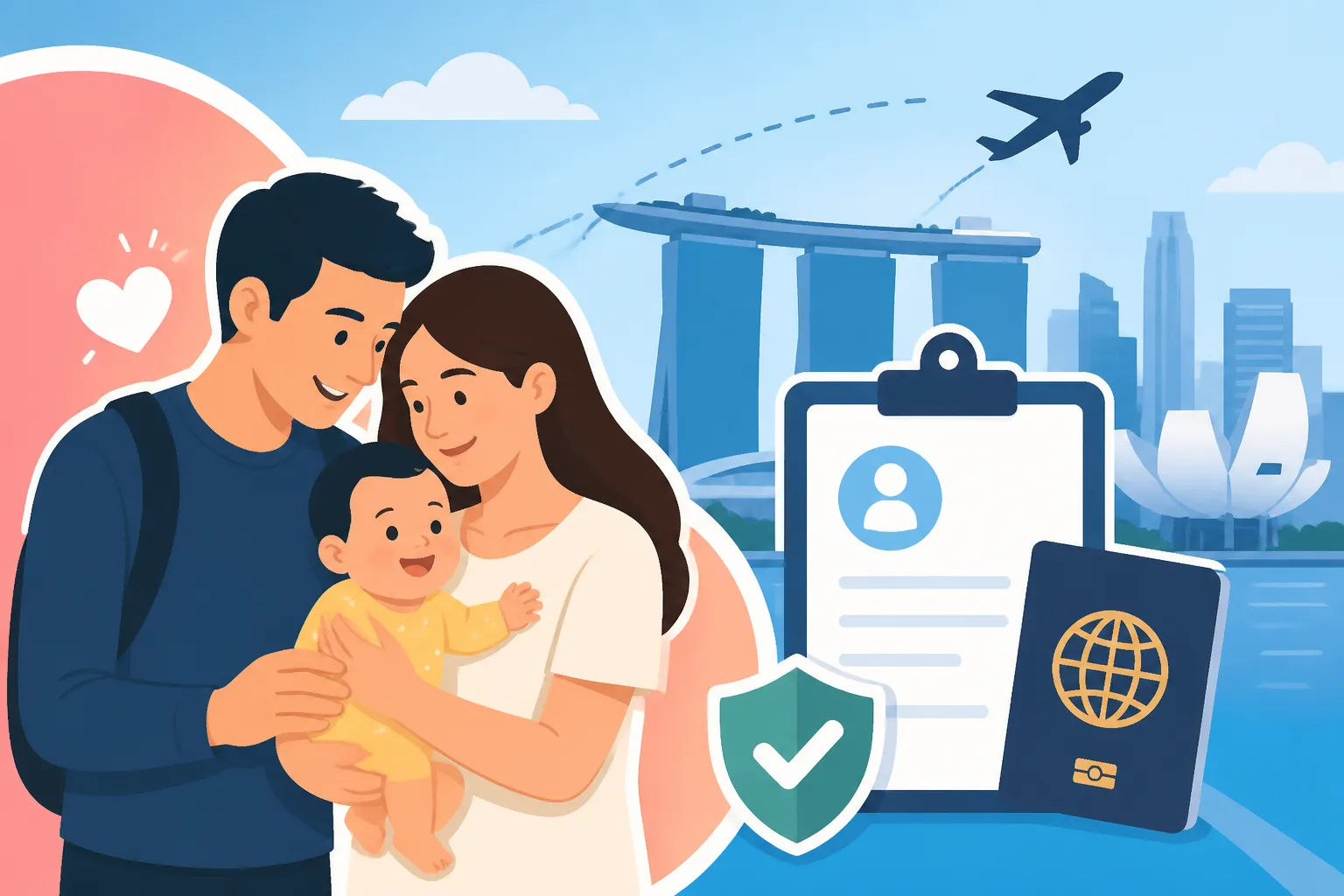
Bringing a Foreign-Born Baby Back to Singapore: Visa Procedures
Having a baby is one of life's most incredible journeys, but when you're an expat, especially if your little one arrives outside of Singapore, it can quickly turn into an administrative marathon. The sheer joy of welcoming a new family member can be overshadowed by a daunting checklist of paperwork to ensure your foreign-born baby can legally enter and reside in Singapore. This guide will meticulously walk you through the visa procedures and vital documentation needed to bring your precious bundle of joy home to the Lion City.
The Initial Whirlwind: Birth Registration and Diplomatic Hurdles
The moment your baby is born in a foreign land, your mind is probably a mix of awe and sheer exhaustion. But for expat parents, this incredible milestone immediately kicks off a complex sequence of administrative tasks. It's not just about celebrating; it's about making sure your newest family member can legally join you in your adopted home. This initial phase, often overlooked in the flurry of excitement, sets the foundation for all subsequent visa applications.
Registering Your Baby's Birth Overseas
The very first and most critical step is to officially register your baby's birth in the country where they were born. This isn't just a formality; it's the genesis of your child's legal identity. Each country has its own specific set of rules and timelines for birth registration, and missing these deadlines can cause significant headaches down the line. You'll typically need to present your passports, marriage certificate (if applicable), and the hospital's birth notification.
For instance, if you had your baby in, say, Thailand, you'd need to register the birth with the local district office (Amphur) within a certain period, usually 15 days. They'll issue a Thai birth certificate, which will likely be in Thai. Don't underestimate the importance of getting certified English translations of this document right away. Many parents make the mistake of thinking their baby’s birth certificate from a non-English speaking country will be accepted as is in Singapore. Trust me, it won't be. Spend the extra time and money to get it professionally translated and notarised. This certified translation will be a cornerstone for all future applications, from passports to Dependant’s Passes. It’s one of those crucial details that, if missed, can stall your entire process, leaving you stranded with a new baby and a pile of unrecognised paperwork.
Notifying Your Embassy or High Commission
Once you have the local birth certificate, your next port of call is your home country's embassy or high commission in the country of your baby's birth. This step is vital for two main reasons: firstly, to officially record your child as a citizen of your home country, and secondly, to apply for their passport. This is where your baby's international identity truly begins to take shape. Many countries offer a "consular report of birth abroad" which serves as proof of citizenship and can facilitate the passport application process.
The process for obtaining a passport for a newborn can be surprisingly arduous. You'll likely need both parents to be present, along with the baby, often requiring an appointment well in advance. Gathering all the required documents – your own passports, marriage certificate, the baby's foreign birth certificate and its certified translation, and sometimes even proof of your continuous residency in your home country or overseas – can feel overwhelming with a newborn in tow. I recall a friend who had their baby in Germany and had to trek across Berlin multiple times to their embassy, navigating public transport with a tiny infant for fingerprinting (yes, even for babies!) and document verification. It's moments like these that make you wish for a magic wand, or at least a super-efficient government office. Be prepared for potential waiting times, as these diplomatic missions often handle a large volume of requests and are subject to their own bureaucratic timelines, which can clash dramatically with the urgent need to get your baby to Singapore.
Securing Your Baby's Travel Documents for Singapore Entry
Once your baby’s birth is registered and you've navigated the initial consular hurdles, the next major milestone is obtaining their actual travel document – a passport. This is non-negotiable for entry into Singapore, and it's also where your baby's identity as a foreign national officially begins for immigration purposes. Without it, you’re simply not going anywhere.
Applying for Your Baby's Passport
This step can be a test of patience, as embassy processing times for newborn passports can vary wildly. Generally, you'll need the certified birth certificate, your own passports, proof of your nationality, and specific passport-sized photos of your baby. And let me tell you, getting a passport photo of a newborn is an art form! They need to be facing forward, eyes open, no shadows, no hands in the way, and a neutral expression. It often takes multiple attempts and a lot of creative baby-wrangling to get one that meets the strict guidelines.
Once the application is submitted, expect several weeks, sometimes even months, for the passport to be issued. It's crucial not to book any flights back to Singapore until you have that physical passport in your hands. A common mistake is to assume an "in-principle approval" or a tracking number is enough. It's not. Singapore immigration requires a valid passport for entry. During this waiting period, if you're managing expenses across borders – perhaps paying for additional legal translations or sending money for family support – consider using services like Wise to handle international transfers, as they often provide competitive exchange rates and transparent fees, which can be a small relief amidst the many financial outlays of a new baby.
The Singapore Entry Approval Process
With passport in hand, your attention now shifts to Singapore's entry requirements. For most foreign-born babies of expatriate parents, this means ensuring they have the correct permissions to enter. All travellers, including infants, must submit an SG Arrival Card (SGAC) within three days prior to their arrival in Singapore. This is a digital health declaration and arrival information form. Missing this simple step can lead to delays at immigration upon arrival, which is the last thing you want with a newborn. For parents who are on Employment Passes (EPs) or S Passes, their baby will typically need a Dependant's Pass (DP) to reside in Singapore long-term.
However, the question often arises: can the baby enter Singapore before the Dependant's Pass is approved? The answer depends on your nationality. Many nationalities are eligible for visa-free entry to Singapore for a certain period (e.g., 30 or 90 days) under a Short-Term Visit Pass (STVP). If this applies to your baby, they can enter Singapore on an STVP and the DP application can be submitted after their arrival. However, if your baby’s nationality requires a visa for entry, you'll need to secure an entry visa before travelling, or ideally, have the Dependant's Pass In-Principle Approval (IPA) letter, which often grants a single-entry visa. My advice? Check the ICA website for your baby's specific nationality requirements well in advance. Never assume; Singapore's immigration rules are stringent and strictly enforced.
Navigating the Dependant's Pass Application for Your Little One
This is the big one. Once your foreign-born baby has their passport and is either in Singapore on a Short-Term Visit Pass or is awaiting their initial entry, the Dependant's Pass (DP) application is the most crucial step to secure their long-term stay. This pass links your child's residency to yours, allowing them to live and thrive alongside you in Singapore.
Eligibility and Sponsor Requirements
For your baby to qualify for a Dependant's Pass, at least one parent must hold a valid Singapore Employment Pass (EP), S Pass, or EntrePass, with a minimum fixed monthly salary of S$6,000. Yes, that's the current benchmark, and it’s non-negotiable. If your combined income doesn't meet this threshold, or if you hold a Work Permit or other non-DP eligible pass, your baby may not qualify for a Dependant's Pass. This often catches new expat parents off guard, especially if their salaries were just shy of the requirement when they first arrived.
It's also important to note that the sponsor for the Dependant's Pass must be the parent who holds the primary work pass (EP, S Pass, or EntrePass). The relationship must be clearly proven through the baby's birth certificate and your marriage certificate, if applicable. If you're wondering about the nuances of this, it's worth checking out "Dependant's Pass (DP) Eligibility: Salary Minimums for Sponsoring Family" for a deeper dive into the specific financial criteria. If one parent is a Singapore Citizen or Permanent Resident, the process might differ slightly, often leading to a Long-Term Visit Pass (LTVP) or even direct citizenship for the child, which we’ll touch on later. The key here is proactive planning and ensuring your current visa status and income align with the DP requirements before the baby even arrives.
Required Documents for a Dependant's Pass
Gathering the documents for a Dependant's Pass can feel like a scavenger hunt, but organisation is your best friend here. The Ministry of Manpower (MOM) requires a comprehensive set of documents to prove your relationship, your eligibility, and your child's identity.
Here's a breakdown of the typical documents you'll need:
| Document Category | Specific Items Required | Notes |
|---|---|---|
| Child's Identity | Completed Dependant's Pass application form | Available on the MOM website, usually submitted online by the sponsoring company or through an employment agent. |
| Copy of child's valid passport particulars page | Ensure it has at least 6 months validity. | |
| Copy of child's birth certificate | This must be the official foreign birth certificate, along with a certified English translation if not originally in English. | |
| Copy of embarkation/disembarkation card (if child entered Singapore on STVP) | Proof of legal entry into Singapore. | |
| Child's passport-sized colour photograph | Taken against a white background, less than 3 months old. | |
| Parent's Identity & Relationship | Copy of sponsoring parent's valid Employment Pass, S Pass, or EntrePass | Ensure it's current and meets the salary requirements. |
| Copy of sponsoring parent's passport particulars page | ||
| Copy of non-sponsoring parent's passport particulars page (if applicable) | Required to show both parents' consent and identity. | |
| Copy of parents' marriage certificate | Required to prove the marital relationship between the parents. If not in English, a certified English translation is needed. | |
| Custody order (if parents are divorced or legally separated) | If only one parent has legal custody, this document is essential. | |
| Company Documents (Sponsoring Parent) | Latest company's ACRA business profile (if sponsoring parent is self-employed or EntrePass holder) | To verify the legitimacy of the sponsoring entity. |
| Letter of support/consent from the sponsoring parent's employer | Confirming employment and salary details, though this is often integrated into the online application by the company's HR. |
You'll typically submit these documents through the MOM’s online portal, usually handled by your employer's HR department or a designated employment agent. It's critical that all documents are clear, legible scans, and that any foreign-language documents come with official English translations. Any discrepancies or missing documents can lead to significant delays, and believe me, you don't want to be in limbo with a newborn!
The Application Process and Timeline
Once all your documents are meticulously gathered, the Dependant's Pass application is typically submitted online by your sponsoring employer (or yourself, if you’re an EntrePass holder). The process is fairly streamlined through the MOM’s EP Online portal. You'll upload all the necessary documents, pay the application fee, and then the waiting game begins.
MOM generally states that most Dependant's Pass applications are processed within three weeks. However, "most" doesn't mean "all," and when it comes to newborns, sometimes it can take longer, especially if there are queries about document authenticity or complex family situations. There are reports of parents waiting closer to six or even eight weeks, especially during peak seasons or when the system undergoes updates. During this period, it’s important to monitor the application status regularly through the EP Online portal. Once approved, you'll receive an In-Principle Approval (IPA) letter, which is fantastic news! This letter will outline the steps for issuance, which usually involves bringing your baby and their passport to the MOM Employment Pass Services Centre (EPSC) at River Valley Road for photo and fingerprint registration (for older children, not typically for newborns), and then collection of the physical Dependant's Pass card. The IPA letter usually specifies a validity period for entry, so make sure to adhere to that. Remember, the journey isn’t over until that little green card is in your hands.
Alternative Scenarios and Special Considerations
While the Dependant's Pass is the most common route for expat parents, there are other pathways and critical considerations, especially for families with a Singaporean connection or those facing unique circumstances. Singapore’s immigration policies are comprehensive but also complex, and understanding these alternative routes can save a lot of stress.
If One Parent is a Singapore Citizen or Permanent Resident
This scenario fundamentally changes the game. If one parent is a Singapore Citizen (SC), your foreign-born baby is automatically eligible for Singapore Citizenship by descent, regardless of where they were born. This is usually the simplest and most direct route. You would register their birth with the Immigration & Checkpoints Authority (ICA) and then apply for a Singapore passport. While the birth happened overseas, the nationality lineage is clear. The key is to act quickly after birth as there are specific timelines for this registration.
If one parent is a Singapore Permanent Resident (PR), the situation is a bit more nuanced. Your baby is not automatically a Singapore Citizen, but they can be included in a subsequent PR application for your family, or you can apply for a Long-Term Visit Pass (LTVP) for them in the interim. The LTVP is a common pathway for spouses and children of PRs who do not yet qualify for PR themselves. Applying for a Long-Term Visit Pass (LTVP) for Parents and Common-Law Spouses might give you some insight into the LTVP process, even though it's focused on other dependants. The advantage of having a PR parent is that it opens up pathways for the child that are not available to children of only EP/S Pass holders, potentially leading to faster integration into the local healthcare and education systems, and eventually, PR or citizenship.
What If Your Baby Needs Medical Care Immediately Upon Arrival?
This is a fear that looms large for any new parent, let alone expat parents with a foreign-born baby. Singapore has an excellent healthcare system, but access for foreigners without established passes can be tricky and expensive. If your baby arrives on a Short-Term Visit Pass (STVP) and suddenly requires urgent medical attention before their Dependant's Pass is issued, they will be treated as a private patient, subject to full unsubsidised rates. This can quickly accumulate into staggering bills. Even with private international health insurance, there might be waiting periods or exclusions for pre-existing conditions (though less likely for a newborn unless there were known complications).
It's critical to have a clear understanding of your own Expat Health Insurance in Singapore: Public vs Private Coverage and to inquire if it extends to a newborn not yet on a Dependant's Pass or if there's a grace period. Ideally, the Dependant's Pass In-Principle Approval (IPA) letter should be issued before travel if there are any known health concerns. Upon arrival, it's wise to locate a General Practitioner (GP) clinic or polyclinic near your residence quickly. Even for minor ailments, having a local doctor already identified can ease stress. You might want to refer to Finding Medical Care: Hospitals, Polyclinics, and GP Networks for guidance on navigating Singapore’s healthcare landscape. The bottom line here is preparedness: know your insurance coverage inside out, and have a contingency plan for medical emergencies.
Financial Realities and Practical Tips for New Expat Parents
The journey of bringing a foreign-born baby to Singapore isn't just about documents; it's also about managing the financial implications and setting up a new life with an expanded family. The costs can be significant, and the practical adjustments demanding, but a bit of foresight can make a world of difference.
Managing Costs of International Birth and Relocation
Having a baby overseas, especially if it was unplanned, can lead to unexpected financial burdens. From hospital bills in a foreign currency to last-minute flight changes and repeated trips to embassies, the expenses can pile up. You might be paying for extra legal translations, document courier services, and visa application fees, all while juggling the standard costs of newborn care. This is where careful budgeting and smart money management come into play. Many expats find themselves needing to transfer funds from their home country or between different currencies. Services like Wise become invaluable here, allowing you to move money efficiently and often with better exchange rates than traditional banks, which can save you a fair bit in transaction costs.
Beyond the initial birth and visa costs, consider the financial impact of bringing all your baby's essentials back to Singapore. Shipping baby gear, clothes, and other necessities internationally can be costly. If you’re coordinating a larger move of personal effects, platforms like Sirelo can be helpful. They allow you to compare quotes from various international moving companies, ensuring you get the best deal for bringing everything from the nursery furniture to the countless boxes of baby clothes back home. You need to account for everything from the initial fees to potentially higher rent if you need a larger place. Looking into Healthcare Budgeting in Singapore: Managing Out-of-Pocket Costs will help you get a better grip on what to expect for ongoing medical expenses for your growing family.
Settling In: Practicalities Beyond Visas
Once the Dependant's Pass is issued and your baby is officially a resident, the real work of settling in begins! This involves everything from finding suitable housing for an expanded family to navigating the local healthcare system for routine check-ups and vaccinations. For housing, you might need to reconsider your current living arrangements. A one-bedroom might have been fine for two, but a baby adds a whole new dimension, making you think about soundproofing, pram storage, and play space. Explore options in Renting in Singapore: The Ultimate Guide for Expatriates (2026) to help you decide on the right fit for your family.
Healthcare is another top priority. Registering your baby with a local pediatrician is essential for their Pediatric Clinics: Childhood Vaccinations and School Medical Forms. Singapore has a comprehensive national vaccination schedule, and ensuring your foreign-born child integrates into this is crucial. You might also want to look into "Choosing a Primary Care Physician (GP) in Singapore" for regular family healthcare needs. Beyond the essentials, think about logistics: where will you buy baby supplies, what kind of childcare options are available if both parents work (considering Hiring a Foreign Domestic Worker (Maid): Levies, Agencies, and Rules), and how will you adapt your daily routines to accommodate a little one in Singapore’s bustling environment? The administrative journey may end with the DP card, but the adventure of raising an expat child in Singapore is just beginning. Make sure you also look into "Financial Checklist for Your First 30 Days in Singapore" to ensure all your financial ducks are in a row.
Disclaimer
This article is for general informational purposes only and does not constitute professional advice. Laws, prices and regulations vary by location and change over time. Consult a qualified professional for guidance on your specific situation.


