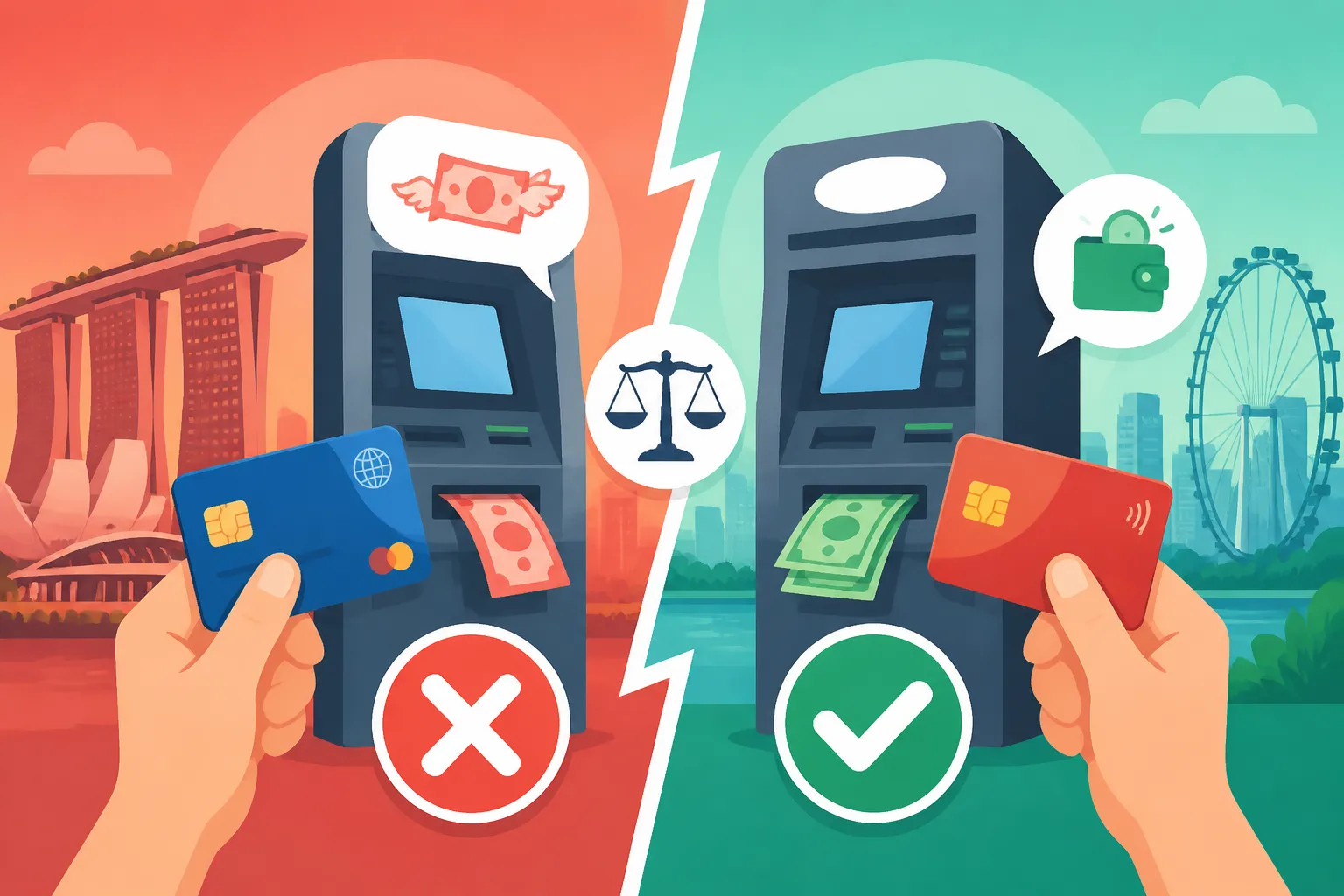
ATM Fees in Singapore: Using Foreign Cards vs Local Debit Cards
Walking up to an ATM at Changi Airport or in the basement of a gleaming Orchard Road mall only to be slapped with a $5 convenience fee—on top of your home bank’s charges—is a frustrating rite of passage for many newcomers. This guide explains how to dodge unnecessary ATM fees, identifies which machines are friendliest to foreign plastic, and details why switching to a local debit card is your best long-term strategy.
The Reality of Singapore ATM Landscape
When you first land in the Lion City, cash might seem like a secondary concern in such a hyper-digital society. However, once you venture into a local hawker center for a five-dollar plate of Hainanese chicken rice, you will quickly realize that while the city is modern, cash is still king in the most authentic corners of the island. The frustration for many expats begins when they realize that not all ATMs are created equal. In Singapore, the banking landscape is dominated by the big three local players: DBS (which includes POSB), OCBC, and UOB. These banks have machines on almost every corner, but if you are using a card from London, New York, or Sydney, these machines often come with strings attached.
One of the most jarring experiences for a new arrival is the sheer density of the network vs. the accessibility for foreigners. You might see a long queue for a POSB machine and a completely empty machine for a foreign bank like HSBC or Standard Chartered right next to it. There is a reason for this: local residents have access to shared networks that foreigners often cannot tap into initially. If you are still in your first week and following your Financial Checklist for Your First 30 Days in Singapore, you are likely relying on your home country's debit card, which means you are at the mercy of both your home bank's "out-of-network" fees and the local Singaporean bank's "access fee."
Furthermore, there is a psychological element to the ATM experience here. Many machines will display a warning about a $5 or $8 SGD fee for "foreign card processing." For someone trying to stick to a tight budget, these fees can eat into a significant portion of a daily allowance. It is essential to understand that while Singapore is incredibly safe and transparent, the banking sector is a business, and "convenience" is a product they sell dearly to those who haven't yet localized their finances.
Using Foreign Cards in Singapore ATMs
If you must use a foreign card, you need to be a savvy operator to avoid "double-dipping" by the banks. The first layer of cost is your home bank’s foreign transaction fee, which is usually a percentage of the total. The second layer is the local ATM operator fee. However, the most dangerous "third layer" is something called Dynamic Currency Conversion, or DCC. This is a subtle trap where the ATM offers to "lock in" the exchange rate for you so you can see exactly how much is being deducted in your home currency.
Never, under any circumstances, accept this offer. When the machine asks if you want to be charged in USD, EUR, or GBP instead of SGD, always choose SGD. If you choose your home currency, the ATM operator applies their own exchange rate, which is almost always 3% to 5% worse than the mid-market rate. By choosing to be billed in SGD, you allow your home bank or a service like Wise to handle the conversion, which is significantly cheaper. Using a multi-currency account like Wise allows you to withdraw small amounts of cash at the real exchange rate, often with the first few hundred dollars of withdrawals being free of any provider fees.
Another hurdle is the "network fee" associated with systems like Plus (Visa) or Cirrus (Mastercard). While almost every ATM in Singapore supports these, the actual cost of the "handshake" between the Singaporean ATM and your bank in Paris or Toronto is often passed down to you. To minimize this, you should aim for larger, less frequent withdrawals. Taking out $500 SGD once is far more economical than taking out $50 SGD ten times, especially when a flat $5 access fee is applied to every transaction. While you are waiting on Opening a Bank Account in Singapore: Required Documents for Foreigners, managing these foreign card withdrawals is a necessary evil that requires strategic planning.
Transitioning to Local Debit Cards
Once you have secured your Employment Pass and your Singpass: The Key to Digital Banking and Government Services, your first priority should be getting a local debit card. This is where the world of "free" banking finally opens up to you. Local debit cards in Singapore generally do not charge any fees for withdrawals at their own bank's ATMs. However, there is a catch that catches many expats off guard: the separation of ATM networks.
In Singapore, DBS and POSB share a massive network. If you have a DBS card, you can use any POSB machine for free. Similarly, UOB and OCBC share a network, meaning a UOB cardholder can use an OCBC machine without a fee, and vice-versa. However, if you take a DBS card to a UOB machine, you might find yourself unable to withdraw cash at all, or you might be charged a cross-network fee. This is a stark contrast to many Western countries where any card works in any machine for a small, standardized fee.
Choosing which bank to go with often depends on where you live and work. DBS has the most machines by far, but also the longest queues, especially on "payday" (usually the 1st and 15th of the month). If you are Comparing Local Banks: DBS vs OCBC vs UOB for Expat Needs, consider the proximity of ATMs to your home. There is nothing more frustrating than needing cash for a taxi and realizing the nearest "free" ATM for your specific bank is three blocks away in the pouring rain.
| Feature | Foreign Debit Card | Local Singapore Debit Card (DBS/UOB/OCBC) | Multi-Currency Card (e.g., Wise) |
|---|---|---|---|
| Withdrawal Fee | $5 – $8 SGD + Home Bank Fee | $0 at network ATMs | $0 (up to a monthly limit) |
| Exchange Rate | Poor (especially if using DCC) | N/A (Local Currency) | Mid-market (Very fair) |
| Convenience | High (Immediate access) | High (Widespread network) | Medium (Requires top-up) |
| Hidden Traps | High (DCC Prompts) | Low (Cross-network limits) | Low (Transparent fees) |
| Best Use Case | Emergency first 48 hours | Long-term daily living | Frequent travel/Early residency |
Managing Cashless Transitions with PayNow
As you settle into your new life, you will find that the need for ATMs actually diminishes. This is thanks to PayNow, a peer-to-peer transfer system that is integrated into every local banking app. In Singapore, you don't "Venmo" someone; you "PayNow" them. This system is linked to either your mobile number or your FIN (Foreign Identification Number). Understanding how PayNow and FAST Transfers: How Singapore Moves Money Instantly work will save you dozens of trips to the ATM every month.
Even at hawker centers, many stalls now display a QR code. You simply scan the code with your local bank app, enter the amount, and the money is transferred instantly. This has revolutionized how expats manage their Budgeting in Singapore: Cost of Living Benchmarks for Expats, as it allows for digital tracking of even the smallest cash-like transactions. However, the caveat remains: PayNow requires a local bank account. Until that account is active, you are stuck in the ATM loop.
During this transitional period, it is also wise to keep an eye on your broader financial footprint. Using foreign cards for everything—including ATM withdrawals—can complicate your record-keeping. If you are using services like Taxes for Expats to manage your home-country tax obligations while living abroad, having a clean trail of local vs. foreign spending is invaluable. Excessive ATM fees are not just a nuisance; they are "leakage" in your financial bucket that can add up to hundreds of dollars over a year.
Practical Tips for Maximizing Your SGD Withdrawals
To avoid the highest fees, stay away from ATMs located inside "tourist traps" or convenience stores like 7-Eleven if you are using a foreign card. These machines are often operated by third-party providers that add an extra layer of "convenience" surcharges. Instead, look for ATMs physically attached to a bank branch. These machines are more likely to have higher withdrawal limits and clearer fee disclosures.
If you are a US citizen or a resident of a country with complex tax laws, remember that cash is harder to track. While the primary focus of Singapore Income Tax for Foreigners: IRAS Rules and Filing (2026) is on your earned income, maintaining a clear digital trail of your transfers via platforms like Wise rather than a series of untraceable ATM withdrawals can make your life much easier during an audit.
Finally, always carry a backup. Singapore's infrastructure is world-class, but ATMs do occasionally run out of cash during major festivals like Chinese New Year. During these times, the "free" ATMs will have massive queues, and you might be forced to use a foreign card at a high-fee machine just to get through the weekend. Plan ahead, withdraw your "festive cash" a week early, and always keep a small "emergency stash" of $50 SGD in your phone case or wallet to avoid that desperate, high-fee midnight run to the machine.
Disclaimer
This guide is for informational purposes only and does not constitute financial, legal, or tax advice. Banking fees, ATM policies, and exchange rates in Singapore are subject to change by individual institutions. Always check the specific terms and conditions of your bank and the ATM operator before proceeding with a transaction. Professional advice should be sought for complex tax or investment situations.