Converting Your Foreign Driver’s License at the Traffic Police HQ
Ah, the driver's license conversion in Singapore. It’s one of those administrative hurdles that almost every expat faces, often with a mix of confusion and a dash of frustration. You arrive, perhaps thinking your international driving permit or home country license will be valid indefinitely, only to discover there’s a distinct process to navigate. This guide is here to untangle that knot, walking you through every step of converting your foreign driver’s license at the Traffic Police Headquarters so you can hit the road with confidence.
Who Needs to Convert Their Foreign Driving License in Singapore?
First things first: figuring out if you even need to go through this whole song and dance. It’s a common misconception that an International Driving Permit (IDP) lets you drive freely for years in Singapore. While an IDP is definitely useful, especially during your initial settling-in period, it's not a permanent solution for residents.
Eligibility and Grace Periods for New Arrivals
If you're a short-term visitor or a tourist, you're usually good to go with your valid foreign driver's license and, if it’s not in English, an International Driving Permit (IDP) or an official English translation. This typically applies for the duration of your short-term visit pass. However, the moment you become a resident in Singapore – meaning you've been granted an Employment Pass, Dependant's Pass, Student Pass, Long-Term Visit Pass, or Permanent Residency – the rules change.
Once your residency officially begins, you are permitted to drive with your foreign license (and IDP/translation if necessary) for a grace period of up to twelve months from your date of arrival in Singapore. This is a crucial window. Many expats, understandably, get caught up in the myriad other tasks of settling into a new country – finding a home, enrolling kids in school, getting Singpass sorted. Before you know it, that twelve-month period is ticking away faster than you’d think. Missing this deadline means you could find yourself unable to legally drive until you successfully complete the conversion process, which involves passing both theory and practical tests, just like a new driver. Trust me, you don't want to be in that position, especially if you're reliant on driving for work or family errands.
Understanding the Permissible Foreign License Types
Not all foreign licenses are created equal in the eyes of the Singapore Traffic Police. Generally, licenses issued by countries that are signatories to the Geneva Convention on Road Traffic (1949) or the Vienna Convention on Road Traffic (1968) are recognised for conversion. Most developed nations, including the US, UK, Canada, Australia, New Zealand, and most European countries, fall under these conventions. However, it's always wise to double-check if your specific country is listed. You can find this information on the Singapore Police Force (SPF) website, which often provides a detailed list of recognised countries.
For those whose licenses are not in English, such as a Japanese or German license, you absolutely must obtain an International Driving Permit (IDP) from your home country's authorised association before arriving in Singapore, or a certified English translation from your embassy, high commission, or a reputable translation service here in Singapore. Don't skip this step – the Traffic Police are very particular about proper documentation. Without it, your conversion application will likely be rejected outright. It’s not just about understanding the rules; it's about providing the clear, unambiguous documentation they require to proceed.
Exemptions and Special Cases
While the general rule is "convert within 12 months for residents," there are a few nuanced situations to be aware of. For example, if you obtained your foreign license while residing in Singapore (e.g., you went back home for a holiday, got a license there, and returned), that license might not be eligible for conversion. The Traffic Police typically want to see that your foreign license was acquired while you were a bona fide resident of the issuing country. They often look for evidence like entry and exit stamps in your passport to verify your residency history.
Another consideration involves specific categories of passes. For instance, those on a Work Holiday Programme (WHP) generally follow similar rules, though the duration of their stay is usually shorter. It's also worth noting that military personnel or diplomats might have different arrangements, often covered under specific bilateral agreements, so if you fall into one of these niche categories, always check with your respective embassy or high commission, and the Ministry of Foreign Affairs (MFA) in Singapore, for precise guidelines. For most expats, however, the standard 12-month rule applies, making proactive planning key to avoiding any inconvenience. If you need to bring your belongings or even your car (which is usually not cost-effective) to Singapore, services like Sirelo can help you plan your move efficiently, ensuring one less headache to deal with amidst the license conversion process.
Kicking Off the Conversion Process: The Basic Theory Test (BTT)
So, you've established you need to convert your license. The very first hurdle for most foreigners is the Basic Theory Test (BTT). Yes, even if you’ve been driving for decades in your home country, you still need to pass this test. It covers Singapore's unique road rules, signs, and traffic regulations, and it's not something to be taken lightly.
Booking Your Basic Theory Test (BTT)
The BTT is offered at the three main driving centres in Singapore: ComfortDelGro Driving Centre (CDC) in Ubi, Singapore Safety Driving Centre (SSDC) in Woodlands, and Bukit Batok Driving Centre (BBDC). You don't need to enrol in driving lessons at these centres to book a BTT. The process is entirely online or via their respective centres’ booking kiosks. You'll need to create an account with your preferred driving centre – and trust me, having a local mobile number and reliable internet is essential for this. A good data plan, perhaps from a provider like Airalo for an eSIM, can make sure you're always connected for these crucial online bookings.
Once you have an account, you can select your preferred test date and time. It's advisable to book well in advance, especially during peak periods or school holidays, as slots can fill up quickly. Remember, you'll need your FIN number (Foreign Identification Number) and your Singpass to register and pay for the test. This digital identity system, crucial for interacting with government services, means you'll need to ensure your Understanding Singpass: The Key to Digital Banking and Government Services is set up and functional.
Preparing for the BTT: Resources and Study Strategies
This isn't just common sense driving; it's about learning the specific nuances of Singaporean roads. For example, understanding the intricacies of Electronic Road Pricing (ERP) gantries, the proper use of bus lanes during different hours, and the rules around school zones are all crucial. The official Basic Theory Test handbook, published by the Traffic Police, is your Bible. You can purchase this at any of the driving centres or sometimes find it online. Read it cover to cover, and then read it again.
Beyond the handbook, there are numerous online mock tests and mobile applications available. These are invaluable for familiarizing yourself with the question format and identifying areas where you need more study. Many expats find these practice tests incredibly helpful in nailing down the specifics, like specific distances for stopping or the exact meanings of less common road signs. Aim for consistent scores of 90% or higher on practice tests before you even consider booking the actual exam. The test environment can be nerve-wracking, so over-preparation is key to building confidence.
What to Expect on Test Day at the Driving Centres
On the day of your BTT, ensure you arrive well in advance of your scheduled time. You'll need to bring your NRIC (for PRs) or FIN card (for EP/DP holders), your passport, and your foreign driving license. Don't forget your glasses or contact lenses if you need them, as you’ll undergo a quick eyesight check before the test. The test itself is a computerised multiple-choice exam, usually consisting of 50 questions, and you have 50 minutes to complete it. You need to achieve at least 45 correct answers (90%) to pass.
The test centres are efficient and modern, but the atmosphere can still feel a bit formal. Take your time reading each question carefully; sometimes, a single word can change the meaning. After completing the test, you'll often get your results immediately. Passing the BTT is a huge relief and a significant milestone in your license conversion journey. If you don't pass, don't despair – you can rebook the test, but remember that each attempt incurs a fee. Many expats, even experienced drivers, find they need a second attempt because they underestimated the local specifics, so learn from your mistakes and hit the books again.
Navigating Singapore's Roads: Practical Lessons and the Driving Test
Congratulations, you've passed the BTT! Now comes what many consider the most challenging part: the practical driving component. Unlike some countries where you simply swap your license, Singapore requires you to prove your driving competency on its roads. This usually means taking lessons with a qualified instructor and passing a practical driving test.
Finding a Driving School and Booking Lessons
While it might seem tempting to try and wing it, taking lessons from a qualified driving instructor is highly recommended, if not almost essential, for most expats. Singapore's roads have their unique characteristics: incredibly efficient traffic flow, strict lane discipline, and often complex road layouts, especially in the central business district. The three main driving centres (ComfortDelGro, Singapore Safety Driving Centre, and Bukit Batok Driving Centre) offer conversion courses specifically tailored for foreign license holders. These courses often focus on familiarising you with local traffic conditions, common test routes, and the specific manoeuvres required during the practical test.
Alternatively, you can opt for private instructors. These instructors usually operate independently but are affiliated with one of the driving centres for booking tests. Private instructors can offer more flexible schedules and sometimes one-on-one attention, which can be beneficial for those with unpredictable work hours. However, ensure your private instructor is properly certified and experienced in preparing foreign drivers for the Singapore test. Regardless of your choice, remember to factor in the cost and time commitment for these lessons. Each lesson typically lasts 60-100 minutes, and most expats require a minimum of 5-10 lessons, if not more, to get comfortable with Singapore's driving style and test requirements.
The Practical Driving Test: Key Areas and Common Challenges
The practical driving test in Singapore is notoriously stringent. It's not just about safe driving; it's about perfect safe driving. You'll be assessed on two main components: the Circuit Test and the Road Test. The Circuit Test, conducted within the driving centre, evaluates your proficiency in various manoeuvres like parallel parking, three-point turns, S-curves, crank courses, and emergency braking. Even seasoned drivers often struggle here because the requirements are so precise. For example, you might be penalised for touching a curb even slightly during parking, or for not maintaining exact distances.
The Road Test takes you out onto public roads, typically around the driving centre. Here, the driving examiner will assess your observation skills, lane discipline, signaling, speed control, ability to handle various traffic situations, and overall safe driving habits. Common expat challenges include adapting to driving on the left-hand side of the road (if you're from a right-hand driving country), understanding complex multi-lane junctions, and consistently checking blind spots and mirrors. The emphasis on defensive driving and precise adherence to rules is paramount. It’s not uncommon for expats with decades of driving experience to fail the practical test multiple times, underscoring the need for thorough preparation and professional guidance.
Booking and Taking Your Practical Driving Test
Once your instructor deems you ready, you can book your practical driving test through your chosen driving centre. Like the BTT, slots can be limited, so plan ahead. You'll need to present your foreign driving license, passport, FIN card/NRIC, and proof of passing the BTT. Ensure you have all the necessary documents for your Mandatory Medical Examinations for Employment Passes and PR Applications in order, as good health is a prerequisite.
On the test day, you'll typically use a school car – either manual or automatic, depending on what you've been learning in. The test car will be equipped with a dual control system for the examiner. Before you even start driving, the examiner will conduct a vehicle check, asking you to identify various components like the engine oil dipstick, battery, and windscreen wiper fluid. Fail this, and your test is over before you’ve even left the parking lot! During the drive, every single error, no matter how minor, accumulates demerit points. Exceeding a certain number of points, or committing an immediate failure offence (like beating a red light or dangerous driving), will result in an instant failure. The pressure is immense, but staying calm and focused, remembering all your instructor's tips, is key. If you don't pass, you'll receive a debrief from the examiner detailing your errors, which you can use to focus your next set of lessons before rebooking the test.
| Stage of Conversion | Key Action | Required Documents | Estimated Cost (SGD) | Important Notes |
|---|---|---|---|---|
| Phase 1: Preparation | Obtain Official English Translation / IDP | Foreign License, Passport | Varies (S$80-S$200) | Must be done before arrival or immediately after. |
| Phase 2: BTT | Study & Book Basic Theory Test | FIN/NRIC, Passport, Foreign License | S$6.50 (test fee) | Essential first step; book online at CDC, SSDC, BBDC. |
| Phase 3: Lessons | Take Practical Driving Lessons | Foreign License | S$80-S$120 per lesson | Highly recommended; 5-10 lessons typically needed. |
| Phase 4: Practical Test | Book & Pass Practical Driving Test | FIN/NRIC, Passport, Foreign License, BTT Pass Slip | S$33 (test fee) | Stringent test; plan for multiple attempts if needed. |
| Phase 5: Conversion | Apply at Traffic Police HQ | All original documents + photos | S$50 (license fee) | Done after passing practical test. |
The Paperwork and the Prize: Collecting Your Singapore Driving License
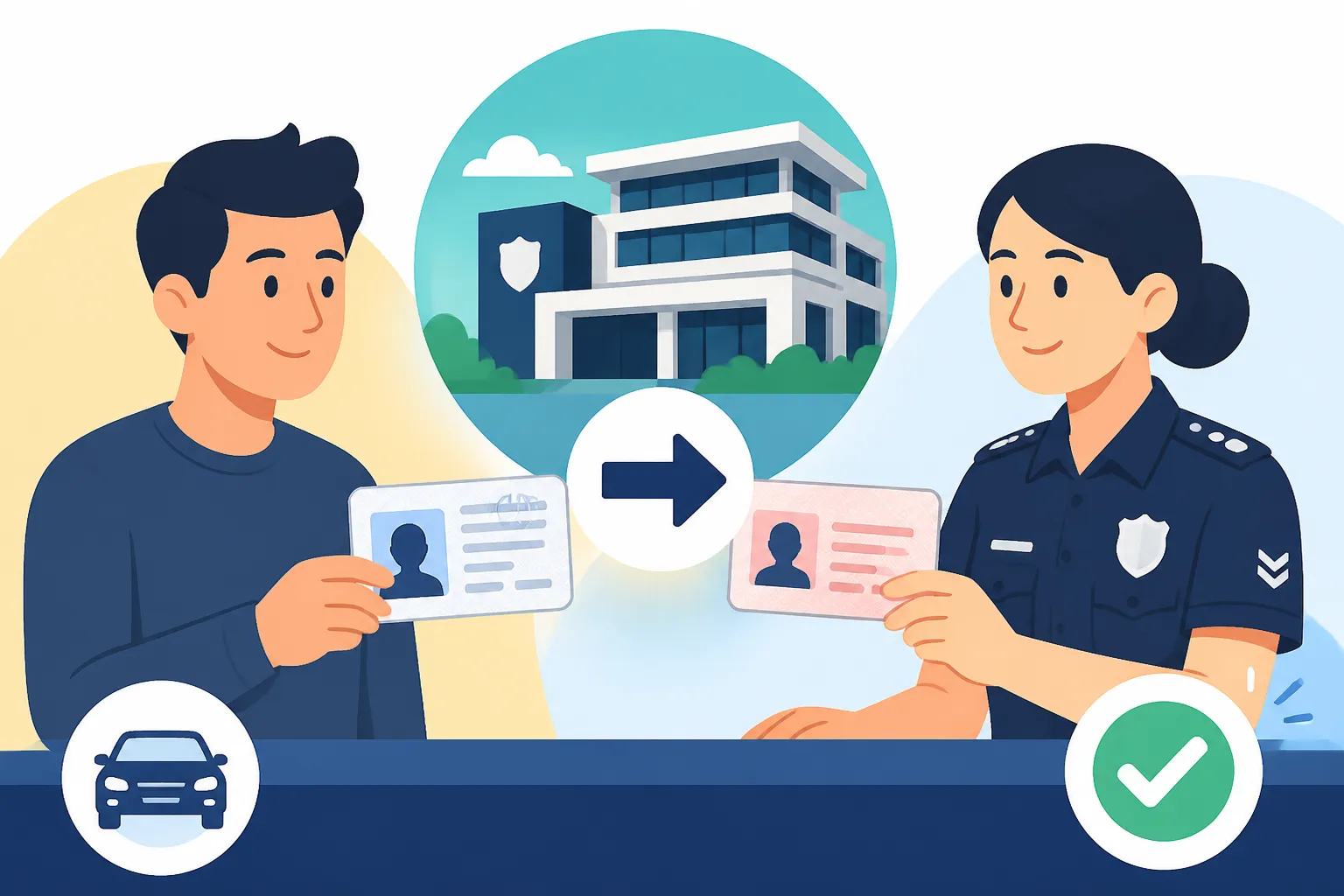
You've done it! You passed the Basic Theory Test and, after what might have felt like an eternity, the practical driving test. The finish line is in sight. The final step is to formally convert your foreign license at the Traffic Police Headquarters (TPHQ).
Required Documents for Conversion at Traffic Police HQ
This is where all your hard work culminates. You’ll need to make an appointment to visit the Traffic Police Headquarters located at 10 Ubi Avenue 3. It’s always best to book your appointment online through the SPF website to avoid long waits – remember, efficient planning is a lifesaver in Singapore’s administrative landscape. On the day of your appointment, you must bring a comprehensive stack of documents. This isn't the time to forget anything!
Here’s a checklist: your valid foreign driving license (the original one!), your passport, your NRIC or FIN card (the physical card, not just a printout), the official English translation of your foreign license or your International Driving Permit (if applicable), proof of the date of your first arrival in Singapore (often checked via ICA’s entry stamp records in your passport), proof of having stayed in the country where your foreign license was issued for a continuous period of at least 6 months, and most importantly, your BTT and practical driving test pass slips. You’ll also need two passport-sized matte photographs. Make sure they meet Singapore’s specific photo requirements (white background, no shadows, clear facial features). It sounds like a lot, and it is, but having everything in order will make the final step seamless.
Understanding Fees and Validity Periods
Once all your documents are checked and verified by the Traffic Police officer, you’ll pay a conversion fee. As of early 2024, the fee for converting a foreign driving license is S$50. This payment can usually be made via NETS, credit card, or PayNow. The officer will process your application, and if everything is in order, you’ll typically receive your shiny new Singapore driving license card on the spot.
This license will usually be valid for a period of five years for foreign residents, after which you’ll need to renew it. Unlike some countries where driving licenses expire on your birthday, Singaporean licenses have a fixed expiry date. You’ll receive a renewal notice in the mail closer to the expiry, but it’s always a good habit to make a note of the date yourself. Losing your driving license is another hassle no one needs, and while the Traffic Police are efficient, replacing a lost card takes time and an additional fee.
Interim Measures and What Happens Next
In some rare instances, if there's a slight hiccup with your documents or if the system is experiencing delays, you might be issued a temporary paper license while your physical card is being prepared. This is perfectly valid for driving. Once you have your Singapore driving license, you are officially good to go! You can now drive legally on Singapore’s roads without the restrictions of the initial 12-month grace period.
This also means you can now consider other aspects of driving life in Singapore, such as understanding Buying a Car in Singapore: COE, Insurance, and Hidden Costs or learning about Electronic Road Pricing (ERP) and Parking Scarcity in the CBD if you plan on getting your own vehicle. For many, having a local license opens up more freedom, whether it’s for weekend trips to Johor Bahru or simply navigating your daily commute beyond public transport. It's a significant milestone in truly settling into life here.
Common Expat Pitfalls and Pro Tips for a Smooth Conversion
The journey to converting your foreign driving license in Singapore can be fraught with unexpected bumps if you're not prepared. Having lived through many bureaucratic processes in this city-state, I've seen countless expats stumble over preventable issues. Here's how to avoid them and ensure a smoother ride.
Avoiding Delays: Common Mistakes Expats Make
One of the biggest mistakes is underestimating the time and effort required. Many expats procrastinate, thinking they have a full year, only to find themselves scrambling as the 12-month grace period dwindles. My advice? Start the BTT preparation as soon as you have your FIN number. Don't wait. The other common error is insufficient preparation for the BTT. As mentioned, it's not "common sense." Singapore's road rules have specifics you won't find anywhere else. Relying on your extensive driving experience from home rather than diligently studying the local handbook is a recipe for failure.
Another frequent pitfall is incomplete documentation. The Traffic Police are sticklers for detail. If your foreign license is not in English, ensure you have either an IDP or an official translation from your embassy or a certified translation service. A simple self-translation or a translation from a non-recognised source will not be accepted. Similarly, ensure your proof of residency in the country that issued your foreign license is clear. Sometimes, a passport stamp might be ambiguous, and they might ask for additional evidence like utility bills or bank statements from that period. For any crucial online bookings, like test slots or appointment changes, having a reliable data connection, perhaps from a global eSIM like Airalo, can prevent frustrating connection issues and missed deadlines.
Dealing with Stress and Language Barriers
The entire process, particularly the practical driving test, can be incredibly stressful. The high standards, the fear of failing, and the financial investment can weigh heavily on anyone. My best advice here is to take deep breaths and approach each step methodically. If English isn't your first language, or if you feel more comfortable receiving instructions in another language, check if the driving centres offer BTT or practical lessons in other languages. While the official tests are in English, some instructors might be bilingual, which can be a huge comfort.
Don't be afraid to ask questions, both from your driving instructor and from the Traffic Police officers during your conversion appointment. Singaporeans are generally helpful, and clarity can prevent misunderstandings. However, be prepared for their directness; it's a cultural norm here. If you're feeling overwhelmed, remember that many before you have successfully navigated this process. Focusing on one step at a time, celebrating small victories like passing the BTT, can help manage the stress levels. Remember, driving is a critical skill, and the rigour of the Singaporean process ensures drivers on the road are competent, contributing to the overall safety for which the country is renowned. This is especially important if you eventually hire a foreign domestic worker, and need to know about Hiring a Foreign Domestic Worker (Maid): Levies, Agencies, and Rules, as they might be driving your family around.
Budgeting for the Full Conversion Cost
Converting your license isn't a one-off fee; it’s a cumulative expense that can catch many expats off guard. Beyond the initial BTT fee (S$6.50) and the final license conversion fee (S$50), the biggest cost will be your practical driving lessons and subsequent practical test fees (S$33 per attempt). Each practical lesson can range from S$80 to S$120, and it's rare for someone to pass with fewer than 5-10 lessons. If you're from a right-hand drive country and now have to adjust to left-hand driving, or vice versa, you might need even more.
Consider the cost of an IDP or certified translation, which can add another S$80-S$200. If you fail the practical test, each re-attempt means another S$33 test fee plus potentially more lessons to iron out your weaknesses. This can quickly add up to S$1000 or even S$2000 for some individuals. Budgeting effectively means setting aside a realistic amount for these costs and understanding that it might not be a single-pass journey. Think of it as an investment in your independence and mobility in Singapore. While Singapore's Public Transport in Singapore: MRT, Buses, and Commuting Hacks is excellent, the freedom of driving for specific needs is often invaluable for expats.
Disclaimer
Please note that while this guide provides comprehensive information based on current regulations and common expat experiences in Singapore, rules and fees can change. It is always advisable to refer to the official websites of the Singapore Traffic Police and the Ministry of Manpower (MOM) for the most up-to-date and authoritative information regarding driver's license conversion and related immigration policies. This article is intended for informational purposes only and does not constitute legal or professional advice.