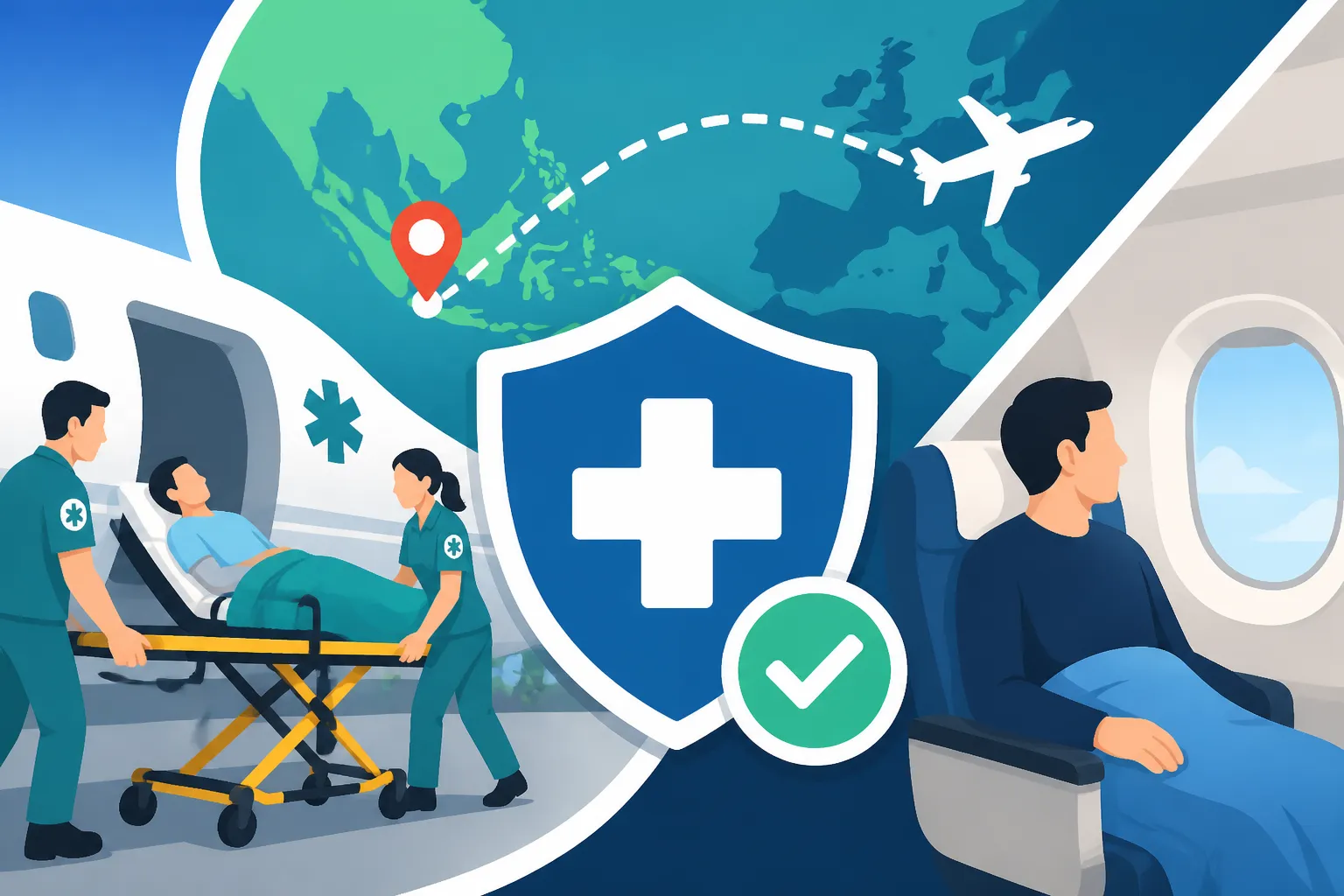
Does Medical Evacuation Insurance Cover Flights Back to the US/UK?
One of the most terrifying thoughts for any expat is being confined to a hospital bed while your family and support system are thousands of miles away in London or New York. I remember sitting in a specialist's office in Novena, clutching a folder of test results, and realizing that if things took a turn for the worse, I had no idea how I’d get back to my home country for long-term care. This guide breaks down the complex reality of medical evacuation insurance and whether it truly covers that flight back to the US or UK.
The Critical Distinction Between Medical Evacuation and Repatriation
When you are scanning through an insurance policy, it is incredibly easy to conflate "Medical Evacuation" with "Medical Repatriation." However, in the insurance world, these are two very different animals. Understanding this distinction is the first step in ensuring you aren't left stranded when you most need a flight home.
What is Emergency Medical Evacuation?
Medical evacuation generally refers to the transport required to get you from a location with inadequate medical facilities to the nearest "center of excellence." In a place like Singapore, this creates a unique situation. Because the Singapore Healthcare System for Expats: Complete 2027 Guide is world-class, the "nearest center of excellence" is almost always right here. If you are injured in a remote part of Southeast Asia, your evacuation will likely bring you to Singapore, not away from it.
Most standard policies, including many travel-focused ones like SafetyWing, are designed to get you to the nearest hospital that can stabilize you. If you are already in a facility like Mount Elizabeth, Gleneagles, and Raffles: Premium Private Hospitals, your insurer may argue that an evacuation is not medically necessary because you are already receiving top-tier care. This is the "been-there" reality that catches many off guard: you might want to go home to the US or UK, but if Singapore can treat you, the insurer isn't legally or contractually obligated to fly you there under an "evacuation" clause.
What is Medical Repatriation?
Medical repatriation is the specific coverage that pays for you to be returned to your home country for ongoing treatment or recovery. This is usually what expats actually want when they talk about "flying back to the US/UK." Repatriation coverage often includes the cost of a medical escort, specialized equipment like a portable ventilator, or even a private air ambulance if you are not fit for a commercial flight.
When I was reviewing plans, I noticed that brands like Cigna Global often offer this as a modular add-on or include it in their higher-tier "Platinum" plans. Without a specific repatriation clause, your "Medical Evacuation" benefit might only cover the cost of getting you to the nearest hospital—which, if you’re already in a ward at SGH, means the benefit is essentially dormant. You must check if your policy includes "Repatriation to Country of Residence or Nationality" to ensure that a flight to the US or UK is on the table.
Returning to the US: High Costs and Private Complexity
For American expats, the logistics of being evacuated or repatriated back to the United States are particularly daunting. The sheer distance from Singapore to the US—roughly 15 to 20 hours of flight time—means that a private air ambulance can cost upwards of S$200,000 to S$300,000.
The Cost of Long-Haul Medical Flights
A repatriation flight to the US isn't just about the fuel; it’s about the medical crew. For a critical patient, this requires at least two flight nurses or a doctor and a nurse, plus enough oxygen and battery power for the equipment to last the entire trans-Pacific journey. If your insurance doesn't have a high limit for Medical Evacuation and Repatriation: Why Expats Need International Cover, you could easily exceed your policy cap before you even touch down in Los Angeles or New York.
Some expats have assumed their $50,000 "evacuation" limit was plenty, only to realize it barely covers the "positioning fee" (the cost of flying the empty medical jet to Singapore to pick you up). For the US, you really need a policy with an "unlimited" or very high six-figure evacuation and repatriation limit. Cigna Global is well-regarded for these high-limit scenarios, providing the financial breathing room required for long-haul medical logistics.
Acceptance at a US Receiving Hospital
Another hurdle for US citizens is the "receiving physician" requirement. Most medical evacuation companies will not wheels-up from Changi until a doctor at a US hospital has formally agreed to accept you as a patient. This can be a bureaucratic nightmare. You have to coordinate between your Singaporean doctors, the insurance company’s medical director, and a US-based hospital. If you don’t have an existing relationship with a US doctor or health system, the insurance company's "assistance wing" becomes your most valuable asset in navigating these Emergency Medical Care in Singapore: Ambulances and A&E Wards protocols.
Returning to the UK: The NHS Factor and Repatriation
For British expats, the conversation is slightly different because of the National Health Service (NHS). While the cost of a flight from Singapore to London is still significant, the "receiving" end of the journey is handled differently than in the US.
Is the NHS a Valid Reason for Repatriation?
One common question is whether you can demand repatriation simply because you want to use the NHS instead of paying for Healthcare Budgeting in Singapore: Managing Out-of-Pocket Costs. Generally, the answer is no. Insurance companies operate on the principle of "medical necessity." If the treatment you need is available at a private hospital in Singapore and you are stable enough to stay, they will rarely pay for a repatriation flight just to save you the cost of local care.
However, if your condition requires long-term rehabilitation—the kind that would exhaust your private insurance limits in Singapore—the insurer might actually prefer to fly you back to the UK. In this scenario, once you are handed over to an NHS hospital, the insurer’s liability for your medical bills ends. This "cost-saving" repatriation is common in long-term disability or chronic illness cases.
Commercial Stretcher vs. Air Ambulance
If you are being sent back to the UK, the insurer will always look for the most cost-effective way to move you. If you can sit in a seat with a nurse beside you, they will book a business-class ticket. If you must remain horizontal, they might use a "commercial stretcher" service, where a block of 6–9 seats is removed from a standard Singapore Airlines or British Airways flight to accommodate a medical bed and equipment. This is significantly cheaper than a private jet but still costs tens of thousands of dollars. Always check if your policy, perhaps a nomad-friendly one like SafetyWing, covers these "commercial medical transport" costs or if they only focus on life-threatening emergencies.
Understanding the "Medical Necessity" Clause
The biggest point of friction between expats and insurance companies is the definition of "medical necessity." This is the gatekeeper clause that determines whether your flight to the US or UK is covered.
Who Decides When You Fly?
You do not get to decide when you are evacuated. Your spouse does not get to decide. Even your local Singaporean doctor doesn't have the final word. The decision is made by the insurance company’s Medical Director, usually in consultation with the treating physician. They will only authorize a flight home if:
- The required treatment is not available locally (rare in Singapore).
- The patient is stable enough to survive the flight.
- Repatriation is more cost-effective for the insurer than continued local treatment.
The "Bed-to-Bed" Guarantee
When shopping for a policy, look for the phrase "bed-to-bed" coverage. This ensures that the insurance company is responsible for the ground ambulance from the Singapore hospital to the airport, the flight itself, and the ground ambulance from the arrival airport to the receiving hospital in the US or UK. Without this, you might find yourself covered for the flight but stuck with a massive bill for the specialized ground transport on either end. There are accounts of families being told the "evacuation" ended at the tarmac, leaving them to figure out how to get a non-ambulatory patient into a hospital.
| Feature | Standard Medical Evacuation | Comprehensive Repatriation |
|---|---|---|
| Primary Goal | Move to the nearest qualified hospital | Move to your home country |
| Common Destination | A hospital in Singapore or Bangkok | A hospital in the US or UK |
| Trigger | Local facility is inadequate | Long-term care or "home-side" recovery |
| Estimated Cost | S$20,000 – S$50,000 (Regional) | S$100,000 – S$300,000+ (Long-haul) |
| Commercial Flight | Rarely covered unless stabilized | Often used with medical escorts |
Choosing the Right Coverage for Your Situation
Not every expat needs the same level of evacuation or repatriation cover. Your choice should depend on your family situation, your "home" health system, and how long you plan to stay in Singapore.
For Short-Term Expats and Nomads
If you are in Singapore on a short-term contract or as a digital nomad, you might rely on travel-heavy plans. SafetyWing is a popular choice here because it is affordable and handles emergency situations well. However, you must read the fine print: their "Emergency Medical Evacuation" benefit is designed to get you to the nearest hospital. If you want a guarantee that you’ll be flown back to your home bed in the US or UK for a long recovery, you might find the coverage limits or "nearest facility" clauses restrictive.
For Long-Term Expats and Families
If you have settled in Singapore and are navigating Expat Health Insurance in Singapore: Public vs Private Coverage, you likely need a more robust international private medical insurance (IPMI) plan. Brands like Cigna Global offer the ability to add "International Medical Evacuation" which specifically includes repatriation to your home country. This is vital if you have children or elderly dependants. If a family member develops a condition that requires months of specialized care, the emotional and financial cost of staying in a foreign country can be overwhelming. Having the option to move the entire medical "theater" back to the US or UK is worth the higher premium.
Practical Steps If You Need to Evacuate
If you find yourself in a situation where evacuation or repatriation is being discussed, you need to act quickly and methodically.
- Call the Assistance Number Immediately: Every international policy has a 24/7 emergency assistance line. Do not wait for the hospital to call them; you or your partner should do it. This starts the "case management" process.
- Gather Medical Reports: The insurer’s medical team will need the latest clinical notes from your doctors in Singapore. If you are at a private clinic, ensure you have a contact for Choosing a Primary Care Physician (GP) in Singapore who can speak to the insurers.
- Check Your "Home" Status: For UK citizens, ensure your NHS record is up to date if possible, though the NHS will treat any citizen in an emergency. For US citizens, contact your US-based health insurance (if you still have it) or your preferred hospital to see if they can provide a "letter of acceptance."
- Confirm the "Escort" Policy: If you are being repatriated, will the insurer also pay for your spouse or children to fly with you? Premium plans often include a "compassionate visit" or "travel for dependants" benefit, but many basic plans do not.
The reality of Expat Health Insurance Portability: Keeping Coverage When You Relocate means that your evacuation rights often change depending on where you are currently "resident." Always keep your address and residency status updated with your insurer to avoid any claims being denied based on your location at the time of the incident.
Comparing Corporate vs. Private Evacuation Benefits
Many expats believe they are fully covered through their employer's group policy. While Understanding Corporate Health Insurance vs Personal Medical Plans often include evacuation, the limits are sometimes surprisingly low. Corporate plans are designed to get you back to work, not necessarily back to your home country for a year of recovery.
If your corporate plan only covers "Evacuation to the nearest facility," you may want to consider a "top-up" or a separate private policy that includes full repatriation. This ensures that if you are ever in a position where you cannot work and your employment pass is cancelled, you have a guaranteed way to get home without bankrupting your family.
Final Thoughts on the Flight Home
Ultimately, medical evacuation insurance can cover flights back to the US or UK, but it is never a "given." It depends entirely on the specific definitions of "repatriation" versus "evacuation" in your policy and whether the insurer deems the move "medically necessary." Don't wait for a crisis to find out that your policy only covers a flight to the nearest hospital. Take the time to sit down with your policy documents—or a broker—and ask the hard question: "If I am in an ICU in Singapore and I want to go to London, who pays for the plane?"
Disclaimer
This guide is for informational purposes only and does not constitute professional medical or financial advice. Insurance policies vary significantly in their terms, conditions, and exclusions. Always review your specific policy wording and consult with a licensed insurance professional or broker before making decisions regarding your healthcare coverage. The costs and regulations mentioned are based on general market conditions in 2026 and are subject to change.