How to Retrieve Your Bank Security Token If Locked Out Overseas
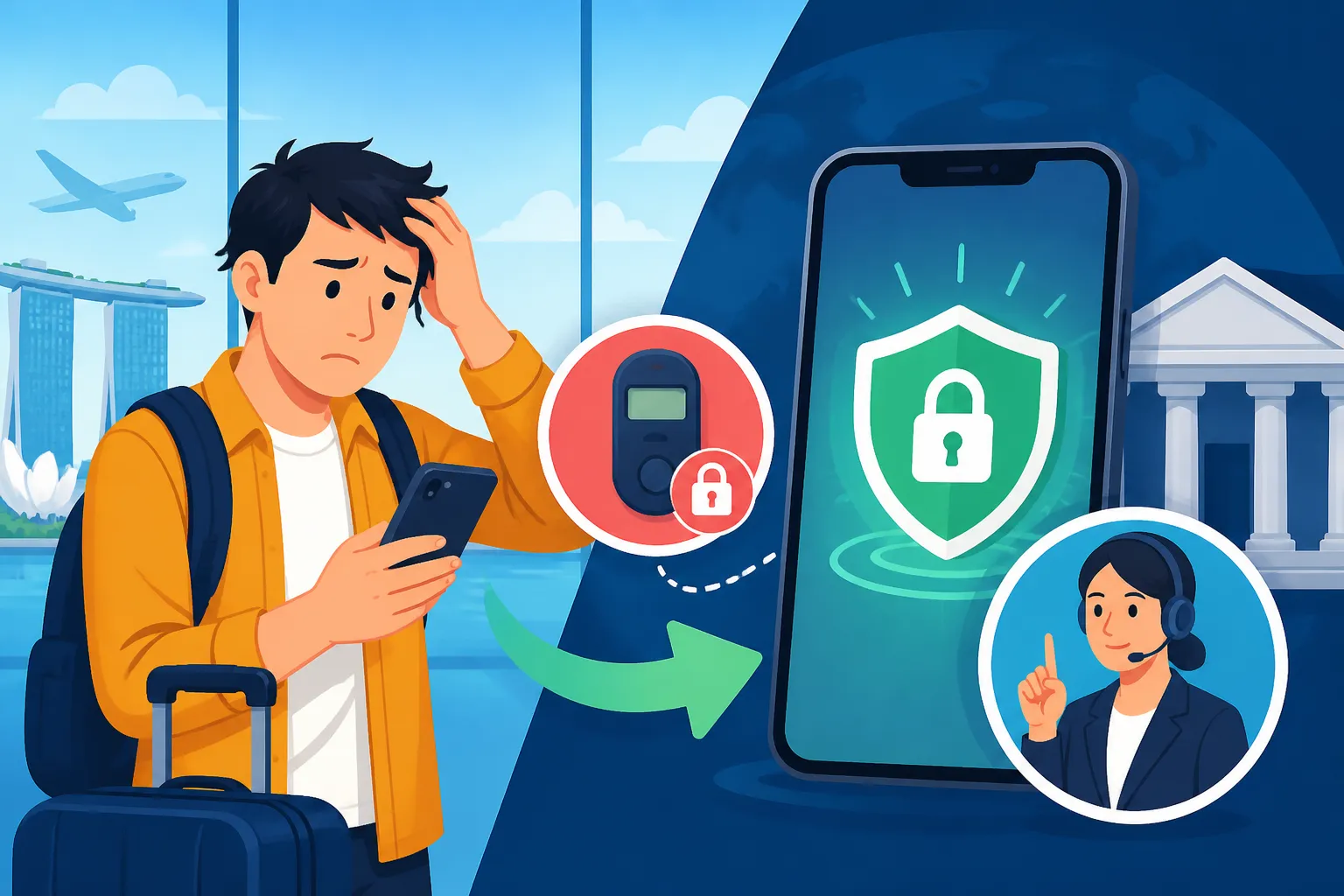
You are sitting in a quiet cafe in London, or perhaps navigating the bustling streets of New York, when you realize you need to settle your final Singapore utility bill or check a tax notification. You reach for that small, plastic rectangle—your bank security token—only to find the screen is blank, the battery is dead, or it has simply vanished from your laptop bag. This guide solves the immediate panic of being locked out of your Singapore bank account while abroad by providing a step-by-step recovery roadmap and digital alternatives to ensure your finances remain accessible.
The Panic of the Dead Token: Why This Happens to the Best of Us
It always seems to happen at the most inconvenient moment. You might be preparing your documents for Singapore Income Tax for Foreigners: IRAS Rules and Filing (2026) or trying to transfer funds to cover a property deposit back home. The reality is that these hardware tokens, while once the gold standard of security, have a finite lifespan. Most batteries in these devices are designed to last between three to five years. If you moved to Singapore several years ago and were issued a token upon Opening a Bank Account in Singapore: Required Documents for Foreigners, you are likely approaching that expiration date right now.
The physical hardware is also surprisingly sensitive to environmental changes. I have known several expats who relocated to cooler, drier climates only to find their Singapore-issued tokens malfunctioning. The internal circuitry can struggle with the transition from Singapore’s high humidity to the dry heat of a European or North American winter. Furthermore, if you have recently changed your phone or updated your mobile OS while overseas, you might find that your digital token—the software-based successor to the plastic dongle—has de-registered itself, leaving you with no way to authenticate your login.
The frustration is compounded by the fact that most Singapore banks require a "One-Time Password" (OTP) via SMS to even initiate a token replacement. If you have already surrendered your Singapore SIM card or if your international roaming is acting up, you are effectively staring at a digital brick wall. This is a common hurdle mentioned in our Banking and Finance for Expats in Singapore: Complete 2027 Guide, where we emphasize the importance of maintaining a secondary access method before you leave the Little Red Dot.
Immediate Steps to Take When You Realize You Are Locked Out
The first thing you should do is stay calm. While it feels like your money is trapped, Singapore’s banking infrastructure is robust, and there are established protocols for overseas clients. Your first port of call should be the bank’s dedicated overseas 24-hour hotline. For DBS, this is generally +65 6339 6666; for OCBC, it is +65 6363 3333; and for UOB, it is +65 6222 2121. Be prepared for a long wait time, especially if you are calling during Singapore’s business hours.
When you finally get through to a customer service officer, you will need to undergo a rigorous identity verification process. Since you cannot provide a token code, they will ask for your NRIC or FIN number, your passport number, and possibly details about your last few transactions. If you are a US citizen or have complex tax obligations, you might be worried about how this lockout affects your reporting. In such cases, using a specialized service like Taxes for Expats can help you manage your filings without needing immediate access to every single bank statement, providing a buffer while you resolve the hardware issue.
Once your identity is verified, the officer will usually offer to mail a new physical token to your overseas address. However, this is not a quick fix. Standard international mail can take anywhere from 10 to 21 business days. If you are in a rush to pay bills, you might want to ask if they can courier the device for a fee. While waiting for the replacement, you can often use a multi-currency platform like Wise to handle urgent transfers to or from other accounts, as these services often have more flexible, app-based authentication that doesn't rely on a physical Singaporean token.
How Each Major Bank Handles Overseas Token Replacement
The process varies slightly depending on who you bank with. DBS/POSB has the most integrated digital ecosystem. If you still have access to your registered email and a working mobile number, you might be able to bypass the physical token entirely by setting up the "Digital Token" within the digibank app. This requires a "cooling-off period" of 12 to 24 hours for security reasons before you can perform high-value transactions. If you have lost all access, they can mail a physical token to your registered overseas address, but ensure your address on file is updated via Understanding Singpass: The Key to Digital Banking and Government Services first.
OCBC and UOB are slightly more traditional in their approach to hardware. OCBC’s "OneToken" is their digital version, but if you require the physical "Hardware Token," you will likely need to submit a formal request through their website or via the hotline. UOB often requires a physical signature on a form if you are changing your mailing address at the same time as requesting a new token. This can add days to the process as you might need to scan and email, or even post, the signed document back to Singapore.
For those who are managing a Cost of Living for an Expat Family with Kids: School, Housing, and Car and have multiple automated payments set up, this delay can be nerve-wracking. I highly recommend checking if your bank allows for "Voice Biometrics" or "Face Verification" as a secondary way to log in. Some banks have introduced these features specifically for customers who are traveling or living abroad and might not have access to their physical security devices.
Transitioning to a Digital Token: The Long-Term Fix
If your bank offers a digital token, take it. It is much harder to lose your phone's internal security chip than it is to lose a small plastic dongle. Most Singapore banks are phasing out physical tokens entirely, so your "Low Bat" warning is actually an invitation to upgrade. The digital token lives inside your banking app and uses your phone’s biometric data (FaceID or Fingerprint) to authorize transactions. This is significantly more secure and convenient for someone living a nomadic or expat lifestyle.
However, there is a catch. If you change your phone, you must "de-enroll" the digital token on the old device before you can activate it on the new one. If your old phone is broken or lost, you are back to square one: calling the hotline to reset your digital credentials. This is why having your Singpass account set up and updated is vital. You can often use Singpass to verify your identity on banking apps, which can save you a two-hour phone call with a bank representative. If you are unsure how to manage this, refer to our guide on How to Use the HealthHub App as a Foreigner with Singpass, which covers the basics of using the Singpass app for various verifications.
Another tip for the long-term is to ensure your contact details are always current. Many expats forget to update their international mobile number when they move. If the bank tries to send a "recovery link" to a Singapore number that has been recycled by the telco, you are in for a major headache. Ensure your profile reflects your current country of residence. This is not just for banking; it’s essential for your global tax compliance as well. Working with an organization like Taxes for Expats can ensure that your financial footprint is consistent across borders, making it easier for banks to verify your residency and identity during a lockout.
Financial Contingency Planning While Overseas
While you are waiting for your new token to arrive in the mail, your financial life shouldn't have to stop. This is where having a diversified "fintech stack" becomes essential. If you have a Wise account, you can often pull funds from your Singapore account (if you have already set up a recurring "pull" or GIRO) or use your linked debit card to move money into a multi-currency wallet. This allows you to continue paying for Setting Up Utilities and Bills: Navigating GIRO and PayNow without needing to log into the main bank portal every time.
It is also worth considering whether you can delegate some of these tasks. If you have a trusted friend or a professional advisor still in Singapore, you might have previously set up a limited Power of Attorney or a joint account. However, for most of us, self-reliance is the name of the game. Always keep a "recovery folder" in a secure cloud service like 1Password or Bitwarden containing scans of your NRIC/FIN, passport, and the specific "Emergency Hotline" numbers for your bank.
If your lockout happens during a critical tax season, the stress can be overwhelming. Services like Taxes for Expats are specifically designed to handle the heavy lifting of international tax forms, which can be a godsend if you are currently unable to access your Singapore bank statements to calculate your exact interest income or tax-deductible expenses. Having these professional buffers in place ensures that a dead battery in a plastic token doesn't turn into a legal or fiscal nightmare.
Comparison Table: Physical vs. Digital Token Recovery
The following table summarizes what you can expect when trying to recover access to the three largest Singapore banks from an overseas location.
| Feature | DBS / POSB | OCBC | UOB |
|---|---|---|---|
| Primary Recovery Method | Digibank App (Digital Token) | OCBC Digital (OneToken) | UOB TMRW App |
| Overseas Mail Option | Yes (Physical Token) | Yes (Physical Token) | Yes (Physical Token) |
| Estimated Delivery | 7-14 Business Days | 10-21 Business Days | 10-21 Business Days |
| Identity Verification | Phone/Face Recognition | SMS OTP / Phone Call | SMS OTP / Security Questions |
| Courier Fee | Approx. S$20 – S$50 | Varies by Region | Approx. S$30 – S$60 |
| Cooling-off Period | 12 – 24 Hours | 12 – 24 Hours | 24 Hours |
Preventive Measures for the Future
To avoid ever being in this situation again, you should perform a "security audit" of your accounts every six months. Check the battery on your physical token by pressing the button; if the display is faint, call the bank immediately for a replacement before you leave the country. If you are already living abroad, try to transition all your accounts to digital tokens. This eliminates the hardware risk entirely.
Another proactive step is to maintain a small balance in an international account that doesn't require a physical token for basic operations. Many modern digital banks use "Push Notifications" for authorization, which work anywhere in the world as long as you have an internet connection. By spreading your liquidity, you ensure that a single point of failure—like a dead DBS token—doesn't leave you stranded without cash in a foreign country.
Finally, keep your Wise account active and linked to your primary Singapore bank via a "Direct Debit" or "GIRO" arrangement if possible. This allows you to move money out of Singapore even if you can't log in to the specific bank portal, as the authorization was granted while you were still in the country. Similarly, keep your tax documents organized through Taxes for Expats so that your annual filings remain on track regardless of your banking access. The goal is to build a financial system that is resilient enough to survive the death of a single piece of plastic.
Disclaimer
This guide is provided for informational purposes only and does not constitute financial or legal advice. Banking procedures and security protocols in Singapore are subject to change by the Monetary Authority of Singapore (MAS) and individual financial institutions. Always verify current procedures directly with your bank. The author is not responsible for any financial loss or issues arising from the use of this information.