Upgrading from an HDB to an EC: Rules and Timelines for PRs
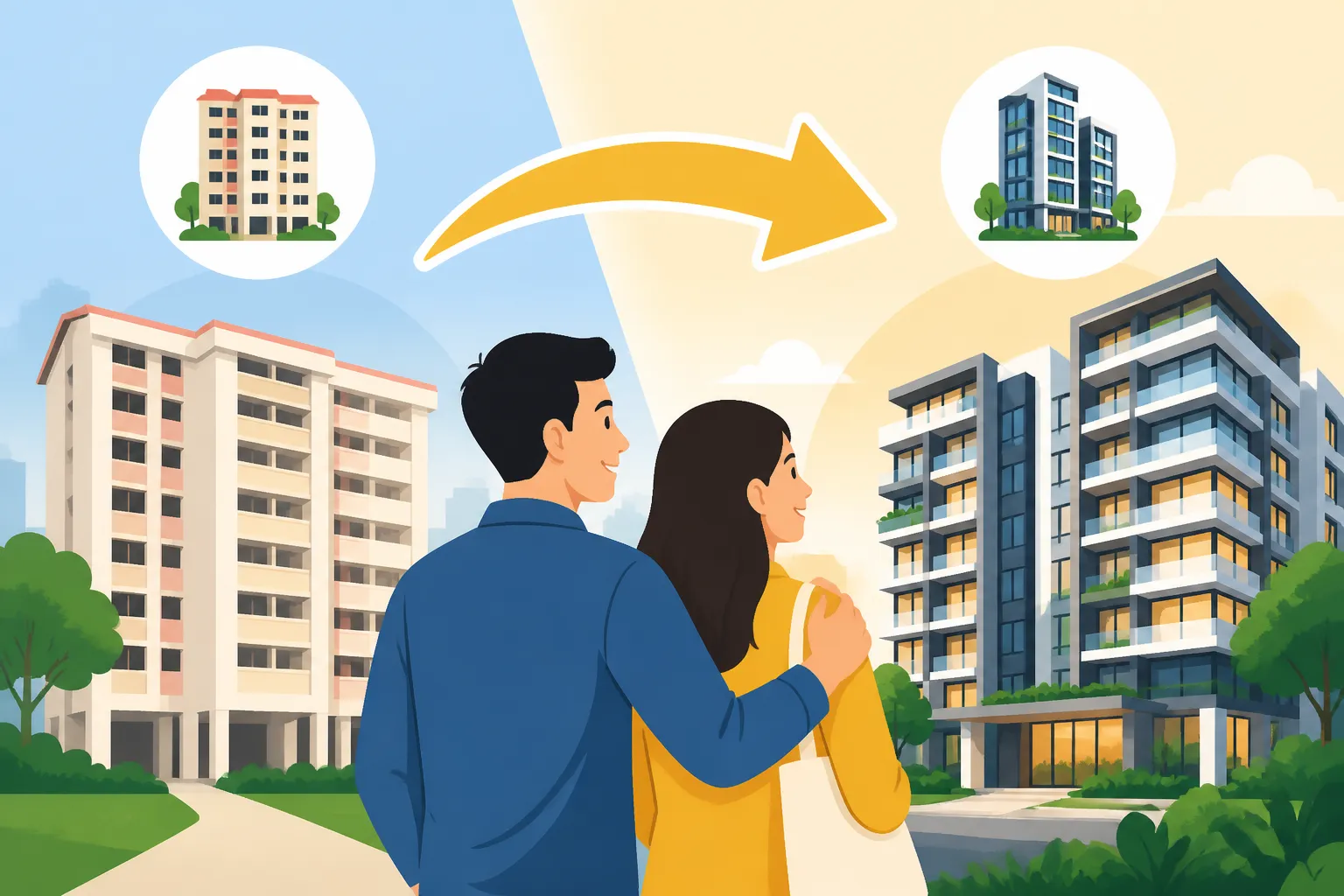
It's a common aspiration for many Permanent Residents (PRs) in Singapore: you've settled into your HDB flat, it's been a fantastic entry point into homeownership here, but now you're eyeing that next step – an Executive Condominium (EC). This upgrade journey from HDB to EC can feel daunting, filled with specific rules, timelines, and financial considerations unique to PRs. This guide is dedicated to breaking down this complex process, giving you the clear, realistic roadmap you need to navigate the world of ECs as a Singapore PR.
The Lure of Executive Condominiums for Permanent Residents
When you first arrive in Singapore, securing an HDB flat as a PR often feels like winning the lottery. It's stable, affordable (comparatively), and a solid foothold in one of the world's most expensive cities. But after a few years, as careers progress and families grow, many PRs find themselves looking for a little more – more space, more facilities, and that "condo lifestyle" without the full private condo price tag. That’s where Executive Condominiums step in, offering a tantalizing bridge.
HDB Living as a PR: The Foundation
For many of us expats who eventually became PRs, buying an HDB resale flat was the sensible first step into Singaporean homeownership. It's often the most accessible option, allowing you to settle down and integrate into local neighborhoods. You learn the ropes of leasehold ownership, maintenance, and the unique HDB community spirit. This initial experience with an HDB is crucial because it sets the stage for your eligibility to purchase an EC. You’ve put in the time, literally, by fulfilling the Minimum Occupation Period (MOP) that’s tied to your HDB flat. This period ensures that HDB flats remain for owner-occupation, preventing quick flips and speculation, which is a key part of the social contract here. If you’re still trying to figure out your initial housing choices, take a look at our guide on HDB vs Condo vs Landed: Choosing Your Singapore Home Type.
What Exactly is an Executive Condominium (EC)?
An EC is essentially a hybrid property. It starts its life as a public-private housing project, built and sold by private developers, but with land subsidies from the government. This means they are initially bought under HDB rules and eligibility criteria, including income ceilings and the MOP. For the first ten years, ECs are subject to restrictions similar to HDB flats. However, after five years (MOP), PRs can sell them to other eligible Singapore Citizens or PRs. Crucially, after ten years, an EC is fully privatized, meaning it can be sold to foreigners, and the property's value typically appreciates to match that of a comparable private condominium, often without the same initial entry cost. This makes ECs incredibly appealing for those looking for the best of both worlds: government support at the start, and full private condo status later on.
Why an EC is the Next Logical Step for Many PRs
The appeal of an EC for a PR is multi-faceted. Firstly, it offers a significant lifestyle upgrade from a standard HDB flat. We’re talking about swimming pools, gyms, clubhouses, and 24-hour security – amenities that many expat families are accustomed to or deeply desire. Secondly, the price point for new ECs, while higher than HDBs, is significantly lower than private condominiums of similar size and location, particularly due to the initial government land subsidies. This makes it a more attainable goal for PRs who have built up some equity in their HDB flat. Finally, ECs offer a clear path to potential capital appreciation. Once they hit the 10-year mark and are privatized, their value often sees a substantial jump, providing a solid investment opportunity. For many, it represents a smart move towards greater financial stability and a more upscale living environment, all within a familiar regulatory framework.
Navigating the Eligibility Maze: Key Rules for PRs
Ah, Singapore's rules and regulations! They're thorough, to say the least. When it comes to housing, especially bridging the gap between public and private, the criteria for PRs can feel like a labyrinth. It’s not just about having the funds; it’s about ticking every single box the Housing & Development Board (HDB) and the Ministry of National Development (MND) have laid out. Missing even one can derail your entire plan, so pay close attention.
The All-Important Minimum Occupation Period (MOP)
This is perhaps the most fundamental rule for any HDB homeowner looking to buy another subsidized property, including an EC. As a PR who owns an HDB flat, you must fulfill a Minimum Occupation Period (MOP) of five years from the date you collected the keys to your HDB flat. During this MOP, you are legally required to physically occupy the flat. You cannot rent out the entire flat, nor can you own any other residential property, local or overseas.
The MOP is calculated from the date of key collection, excluding any periods where you were not residing in the flat, such as if you worked overseas and obtained approval to rent out a room. Only upon successful completion of this MOP are you eligible to purchase a new EC from a developer. This means you can't just buy an HDB and flip it quickly to get an EC; Singapore wants you to make a home first. If you're pondering your long-term status, understanding Permanent Residency (PR) in Singapore: Paths, Points, and Processes is essential, as your PR status is foundational to these housing rules.
Citizenship Requirements and PR Status Length
While ECs are eventually privatized, their initial purchase falls under HDB rules, which are primarily designed to benefit Singapore Citizens (SCs). For PRs, the eligibility criteria become a bit tighter.
- Family Nucleus Requirement: To purchase a new EC, you must form a valid family nucleus with at least one other Singapore Citizen or another Permanent Resident. This typically means you must be married, or forming a family with parents or children. Single PRs generally cannot buy new ECs directly from a developer. This is a significant point of frustration for many single expat PRs who have established roots here but don't fit the "family nucleus" mold.
- PR Status Duration: While there isn't a specific number of years you must have been a PR to buy an EC (unlike some other HDB schemes), the general expectation is that you are a well-integrated, contributing member of society. Your ability to meet other criteria, such as the MOP on an existing HDB, naturally implies a certain length of PR residency.
Income Ceilings and Other Ownership Restrictions
ECs are part of a scheme to provide affordable private-like housing for the "sandwiched" class – those who earn too much to qualify for BTO flats but find private condos out of reach. As such, there are strict income ceilings.
- Monthly Household Income: The total gross monthly household income for all applicants must not exceed S$16,000. This is a hard cap. If your combined income goes even a dollar over, you’re ineligible. This can be tricky for high-earning expat PR couples who might just miss out on the EC dream. This ceiling is reviewed periodically, so always check the latest HDB announcements.
- No Other Property Ownership (During Application): At the time of EC application, neither you nor your co-applicant(s) should own any other residential property, whether locally or overseas. This includes HDB flats, private condominiums, or any other form of housing. If you own an existing HDB flat, you will be required to dispose of it within six months of collecting the keys to your new EC. This brings us to the next crucial point.
The "No Other Property" Rule: Disposing of Existing Properties
This is where planning truly becomes critical for PRs transitioning from an HDB to an EC. As mentioned, you cannot own another property when applying for a new EC. If you currently own an HDB flat, you must commit to selling it within a specified timeframe.
The typical process involves:
- Applying for the EC while still owning your HDB (assuming MOP is met).
- If your EC application is successful and you book a unit, you will sign an Option to Purchase (OTP).
- You then have a period (typically six months from key collection of the EC) to sell your existing HDB flat.
This staggered process means you’ll temporarily be a "two-property" owner during the transition. However, it's vital to ensure your HDB sale aligns with the EC's completion and key collection to avoid penalties or being unable to take possession of your new EC. It also means you’ll be juggling the sale of one property with the purchase and payment schedule of another. Many PRs consider the implications of additional taxes when considering multiple property ownerships; our guide on Additional Buyer’s Stamp Duty (ABSD) Rates for Foreigners can offer further insights, although for HDB to EC, the primary concern is the disposal timeline.
The Practical Path to EC Ownership: Application and Purchase
Okay, so you’ve checked all the eligibility boxes, confirmed your MOP is done, and you’re convinced an EC is your next home. Now comes the exciting, yet incredibly detailed, part: the actual application and purchase process. This isn't like buying a private condo where you simply walk into a showroom and sign papers (though there's some of that too!). You're still dealing with HDB rules, which means paperwork, deadlines, and strategic timing.
Timing Your HDB Sale and EC Purchase
One of the trickiest aspects for PRs upgrading from an HDB is managing the sale of your current flat simultaneously with the purchase of your new EC. Ideally, you want to sell your HDB after you’ve secured your EC unit, but before you need to move into the EC. This minimizes the period where you might need temporary accommodation.
- The Wait for EC Completion: New EC projects are sold "off-plan," meaning they are still under construction. The completion (TOP – Temporary Occupation Permit) can take 3-4 years. This gives you ample time to sell your HDB flat closer to the EC's completion date.
- Selling Your HDB: Once your HDB MOP is fulfilled, you can begin the process of selling your flat on the open market. This involves engaging an agent (or going DIY), marketing your property, negotiating with buyers, and applying to HDB for the transaction. Remember, after accepting an Option to Purchase (OTP) from a buyer, you’ll typically have 8 weeks to complete the transaction. When it's time to pack up your HDB and prepare for the move, remember to research reputable moving companies; platforms like Sirelo can be incredibly helpful for comparing quotes and services to make your transition smoother.
- Temporary Housing: If your HDB sells faster than your EC is ready, you might need to find temporary accommodation. This could mean renting a condo for a few months. Be prepared for this possibility and factor in rental costs. If you find yourself in this situation, our guide on Renting in Singapore: The Ultimate Guide for Expatriates (2026) could offer valuable tips.
The Application Process: From E-Application to Booking
The journey to owning an EC typically follows these steps:
- E-Application: Developers will launch new EC projects with an "e-application" period. This is where you submit your interest online, providing basic details and confirming your eligibility. You typically need to provide your Singpass details for verification. Using your Singpass Login for ICA: Navigating the Electronic Permanent Residence (e-PR) System will be crucial for accessing various government services, including HDB's portals related to your current and future properties.
- Balloting: Due to high demand, new ECs are often oversubscribed. Developers conduct a balloting exercise to determine who gets to view and book units. Your ballot queue number is critical.
- Showflat Viewing & Booking: If you get a good queue number, you'll be invited to view the showflat. This is your chance to choose your preferred unit. If you like a unit, you'll pay a booking fee (e.g., 5% of the purchase price) and sign the "Option to Purchase."
- Legal Formalities & Sales Agreement: Your solicitor will then prepare the Sale and Purchase Agreement. This usually happens within 8 weeks of signing the OTP. You'll sign this, and pay the remaining 15% of the downpayment, plus stamp duties (Buyer’s Stamp Duty and, if applicable, Additional Buyer's Stamp Duty). Understanding the nuances of Property Taxes and Stamp Duties: The Financial Cost of Buying Real Estate is critical here.
- Construction & Key Collection: The developer will proceed with construction. Upon completion (TOP), you’ll be invited for key collection and the final handover process. This is the moment you've been waiting for!
Financing Your EC: Grants, Loans, and Cash Outlays
Financing an EC involves a blend of grants, bank loans, and your own cash/CPF savings.
- Grants for PRs: As a PR, your eligibility for HDB grants for ECs is limited. Only PR households with at least one Singapore Citizen (SC) co-applicant or family member can potentially qualify for grants like the CPF Housing Grant, but typically, only SCs receive the full benefits. If you are a pure PR household (both applicants are PRs), you generally won't be eligible for HDB grants. This is a common point of disappointment but important to manage expectations.
- Bank Loans: Unlike HDB flats where you can get an HDB loan, ECs require a bank loan. You'll need to approach commercial banks (DBS, OCBC, UOB, etc.) for financing. Banks will assess your income, credit history, and overall financial health. It's wise to get an "Approval-In-Principle" (AIP) from a few banks before you apply for an EC to know your borrowing capacity. The Loan-to-Value (LTV) limit is typically 75% for your first housing loan, meaning you need to pay at least 25% of the purchase price as a downpayment.
- Using Your CPF: You can use your Ordinary Account (OA) savings in your Central Provident Fund (CPF) for the downpayment and to service your monthly mortgage installments. This is a huge advantage for PRs who have contributed to CPF for several years. For more on this, check out CPF and SRS Basics: What Permanent Residents and Expats Must Know. However, remember there are withdrawal limits, and you might need a substantial amount of cash readily available for the initial booking fee and other upfront costs not covered by CPF.
Financial Implications and Strategic Considerations
Upgrading to an EC is a significant financial commitment, arguably one of the biggest you’ll make in Singapore. Beyond the sticker price, there are numerous costs, market dynamics to consider, and logistical hurdles to plan for. Don't rush this part; a clear financial strategy is your best friend.
Costs Beyond the Price Tag: Stamp Duties and Fees
When you buy an EC, the initial booking fee is just the beginning. You’ll encounter several other substantial costs:
- Buyer’s Stamp Duty (BSD): This is mandatory for all property purchases in Singapore, calculated on the purchase price or market value (whichever is higher). It’s a tiered system, ranging from 1% for the first S$180,000 to 4% for amounts above S$1 million. For a S$1.5 million EC, the BSD can easily be upwards of S$40,000 to S$50,000.
- Additional Buyer’s Stamp Duty (ABSD): As a Singapore PR, if this is your first property purchase in Singapore, you do not pay ABSD. However, if you already own one residential property (even if it's an HDB and you're selling it), you will be liable for ABSD on the second property. For PRs, the ABSD rate is 5% for the first property and 30% for the second and subsequent properties. The good news is that if you are a PR purchasing an EC and you commit to selling your only existing HDB flat within six months of your EC's TOP (or legal completion, whichever is earlier), you may be eligible for an ABSD remission. This is critical to understand and plan for!
- Legal Fees: Engaging a property lawyer is essential. These fees typically range from S$2,500 to S$5,000, depending on the complexity and property value.
- Agent Commissions (for HDB sale): If you use an agent to sell your HDB flat, expect to pay a commission, usually 1% to 2% of the selling price.
- Renovation and Furnishing: New ECs are usually sold with basic fittings. You'll likely want to personalize and furnish your new home, which can run into tens or even hundreds of thousands of dollars.
- Maintenance Fees: Unlike HDBs with relatively low conservancy charges, ECs come with monthly maintenance fees, similar to private condos, to cover the upkeep of facilities like pools, gyms, and security. These can be several hundred dollars a month.
Market Outlook and Investment Potential for ECs
ECs have historically performed well in Singapore’s property market, often seeing good capital appreciation after the 10-year privatization mark.
- Initial Price Advantage: The subsidized land cost means ECs are generally sold at a lower price point than comparable private condominiums in the same area.
- Demand: They cater to a strong segment of the population (the "sandwiched" class) and PRs looking for an upgrade, ensuring consistent demand.
- Privatization Boost: The 10-year mark is often a critical point for price appreciation, as the property can then be sold to foreigners, widening the buyer pool significantly. Many savvy investors (and homeowners) see this as a key strategic advantage.
- Location, Location, Location: Just like any property, the EC’s location, proximity to MRT stations, good schools, and amenities will heavily influence its long-term value. Do your research on upcoming developments in the area that could enhance or detract from its value.
Navigating the Transition: Temporary Housing and Moving Logistics
The period between selling your HDB and collecting keys to your EC can be a logistical headache.
- Bridging Loans: If you need funds from your HDB sale to finance your EC, but your EC is ready before your HDB sale completes, you might consider a bridging loan. These are short-term loans from banks designed to tide you over.
- Rental Accommodation: As mentioned, a temporary rental might be necessary. This means another security deposit (usually 1-2 months' rent), stamp duty, and potentially agent fees. Be mindful of minimum rental periods – HDBs require 6 months, private properties typically 3 months, but landlords usually prefer longer leases. Consider Initial Rental Costs: Security Deposits, Stamp Duty, and Advance Rent for these expenses.
- Moving Companies: Once both properties are sorted, the actual move will require careful planning. Hiring reliable movers is key. Services like Hiring Movers in Singapore: Lalamove, GoGoX, and Full-Service Companies can help you find suitable options, but book in advance, especially during peak moving seasons.
- Staying Connected: If your job requires you to travel frequently during this transition period, perhaps while you're sorting out your HDB sale and waiting for your new EC, ensure your connectivity. Services like Airalo can be a lifesaver for staying connected without racking up huge roaming bills while you're managing things remotely or during short trips.
Here’s a quick overview of the key differences and requirements:
| Feature | HDB Flat (Resale) | Executive Condominium (New Launch) |
|---|---|---|
| Initial Ownership Type | Public Housing | Hybrid (Public-Private) |
| Eligibility (PRs) | Married couple (PR+SC, or PR+PR with 3+ years PR) | Married couple (PR+SC, or PR+PR) |
| Minimum Occupation Period (MOP) | 5 years | 5 years from TOP/Key Collection |
| Income Ceiling | None (for resale purchase) | S$16,000 (gross monthly household income) |
| Other Property Ownership | No other properties locally or overseas (at purchase) | No other properties locally or overseas (at application); must dispose of HDB within 6 months of EC TOP |
| Facilities | Basic (playgrounds, fitness corners, hawker centres) | Condo facilities (pool, gym, clubhouse, security) |
| Financing | HDB loan or Bank loan | Bank loan only |
| Government Grants (PRs) | Limited (usually for SC+PR couples) | Extremely limited/None (for PR-only households) |
| Privatization | Remains HDB | Fully privatized after 10 years (can sell to foreigners) |
| Indicative Price Range | S$400,000 – S$900,000+ | S$1,000,000 – S$1,800,000+ (new launch) |
Upgrading from an HDB to an EC as a PR in Singapore is a well-trodden path for many, offering a compelling blend of lifestyle enhancement and investment potential. However, it requires meticulous planning, a deep understanding of the regulations, and careful financial management. Don't underestimate the details, and always seek professional advice where necessary.
Disclaimer
The information provided in this guide is for general informational purposes only and does not constitute financial, legal, or property advice. Property rules and regulations in Singapore, especially those concerning HDB and ECs for Permanent Residents, are subject to change by relevant authorities such as HDB and MND. Readers are strongly advised to consult official government sources (HDB, IRAS), licensed property agents, and qualified legal and financial professionals for personalized advice based on their specific circumstances. While every effort has been made to ensure accuracy, we cannot guarantee that the information is free from errors or omissions.