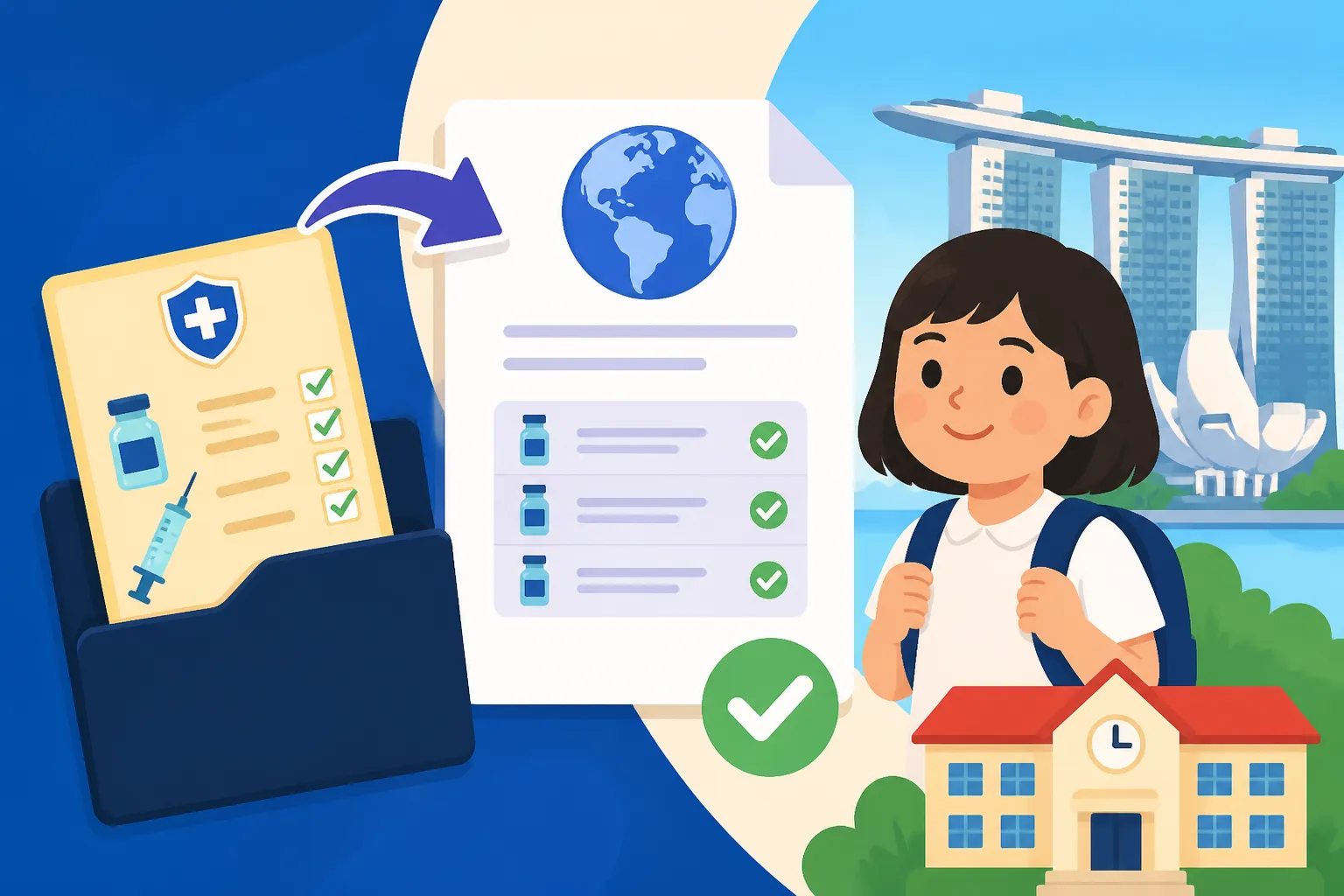
Translating Foreign Vaccine Records for Singapore School Admissions
The bureaucracy of Singaporean school admissions can feel like a full-time job, especially when you realize your child's medical records from back home aren't official enough for the Ministry of Health. I personally spent three frantic weeks running between clinics because my son's European vaccination booklet lacked the specific stamps required by the National Immunisation Registry. This guide breaks down the exact steps to translate, verify, and digitize those records without losing your sanity or your school placement.
Understanding the National Immunisation Registry and the NCIS
In Singapore, the National Immunisation Registry (NIR) is the central database that tracks the vaccination status of every child in the country. For expats, this is the gatekeeper for school admissions and even the issuance of long-term passes for children. The registry follows the National Childhood Immunisation Schedule: What Your Child Must Have very strictly. If your child was born in a country with a different schedule, such as the UK or the US, you might find that you have "gaps" in the eyes of the Singapore government, even if your home country's pediatrician said your child was fully covered.
The core reason for this stringency is public health legislation. In Singapore, vaccination against Diphtheria and Measles is mandated by law. Without proof of these specific vaccinations being recorded in the NIR, a child cannot be enrolled in any local or international school. This is often where the headache begins for newcomers. You might have a perfectly valid record in German, French, or Japanese, but the Health Promotion Board (HPB) cannot accept these directly. They require a specific verification process that bridges the gap between your home country's records and the Singaporean database.
When you are navigating these early administrative hurdles, it is a good idea to check if your Expat Health Insurance in Singapore: Public vs Private Coverage includes provisions for administrative medical fees. Some comprehensive plans from providers like Cigna Global may cover the consultation costs associated with these mandatory record verifications, though the "paperwork fee" itself is often an out-of-pocket expense. Understanding this distinction early can save you from unexpected small bills that add up during a move.
The Verification Process for Foreign Records
The process of "translating" your records is actually a two-part task: linguistic translation and medical verification. If your records are not in English, you must first get them translated by a certified translator or an embassy-approved service. However, even if your records are in English, they are not automatically entered into the NIR. You must visit a local doctor to have the records "verified" and "uploaded." This is a step many expat parents miss until the school’s admissions officer sends a follow-up email with an urgent deadline.
Your first step is Choosing a Primary Care Physician (GP) in Singapore who is familiar with the NIR system. Not all clinics handle this frequently, so it is often better to look for Pediatric Clinics: Childhood Vaccinations and School Medical Forms specifically. You will need to bring the original hard copy of your child's vaccination records, the translated version (if applicable), and your child's passport and birth certificate. The doctor will review the dates and dosages to ensure they match the Singaporean requirements. For example, Singapore requires a second dose of the MMR vaccine, and if your home country only required one by age four, your child will need a "catch-up" dose before the doctor can sign off.
During this visit, the doctor will fill out a "Verification of Vaccination" form. This form is then submitted to the NIR. It can take anywhere from two to four weeks for the records to reflect in the government system. Once they are live, you can access them via the National Immunisation Registry (NIR) Online Portal or the government's mobile application. Being able to show a digital "Green" status on the app is the gold standard for school admissions.
| Vaccine Component | Common Global Term | Singapore NIR Requirement | Mandatory for School? |
|---|---|---|---|
| Diphtheria | DTaP / DTP | Minimum 3 doses + boosters | Yes (By Law) |
| Measles | MMR / MMRV | 2 doses | Yes (By Law) |
| Polio | IPV / OPV | Part of 5-in-1 or 6-in-1 | Required for NCIS |
| Hepatitis B | HepB | 3 doses (at birth, 1m, 6m) | Required for NCIS |
| Tetanus | T / Tdap | Included in multi-component | Required for NCIS |
| Hib | Haemophilus Influenzae | 3 doses | Required for NCIS |
Translation Requirements and Missing Documentation
If your records are in a language other than English, you cannot simply translate them yourself. The Ministry of Health and the ICA generally require translations from the embassy of the country that issued the record or a professional translation service in Singapore that is recognized by the authorities. This is a common point of frustration for expats from non-English speaking countries, as the costs for these translations can be surprisingly high.
What happens if you have lost the original records? This is a nightmare scenario many newcomers face. If you cannot produce a physical or digital record from your home country, a Singaporean doctor cannot simply take your word for it. In these cases, you will likely need to undergo serology testing (blood tests) to prove immunity. You can find more about this by checking Can I Get a Blood Test at a Clinic Without a Doctor's Referral as it explains how clinics handle these requests. These tests check for antibodies for Measles and Diphtheria. If the levels are high enough, the doctor can use those results to update the NIR. If not, your child will have to be re-vaccinated according to the Singaporean schedule.
For families who are still in the transition phase and haven't fully settled into their long-term Singaporean health plan, having a flexible option like SafetyWing can be useful for general medical inquiries or if a child reacts to a catch-up vaccination during those first few months. While SafetyWing is primarily travel-focused, it provides a safety net while you are busy sorting out the mountain of paperwork that comes with International Schools in Singapore: Choosing the Right Curriculum.
Handling Gaps and Catch-Up Schedules
One of the most frequent issues for expat parents is the "timing gap." For instance, the Singaporean schedule might require a specific booster at age 10, whereas your home country suggests age 12. If you arrive in Singapore with an 11-year-old, the school system will flag your child as "non-compliant." You will need to work with a local doctor to create a catch-up schedule. This isn't just about health; it's about the administrative "tick-box" that allows the school to finalize the enrollment.
When you visit a clinic for this, ask specifically for a "Certificate of Vaccination for School Entry." This is a specific document that the school’s registrar will recognize. If you are struggling with a language barrier at general clinics, you might find it easier Finding a Pediatrician Who Speaks Your Native Language to ensure the nuances of your child's medical history are correctly understood. I’ve found that doctors at international-leaning clinics are much more accustomed to the variations between the American CDC, the UK NHS, and the Singaporean MOH schedules.
Be prepared for the costs. The consultation to review records, the NIR submission fee, and any necessary catch-up vaccinations can quickly run into the hundreds of dollars. This is an essential part of Healthcare Budgeting in Singapore: Managing Out-of-Pocket Costs. While premium plans like Cigna Global often cover outpatient vaccinations, they might not cover the specific "administrative fee" charged by clinics to process the NIR paperwork. Always ask for a breakdown of the bill so you can see what is a medical procedure and what is a processing fee.
Accessing Your Digital Records via HealthHub
Once the doctor has submitted your records to the NIR, the final step is ensuring they are actually there. In Singapore’s "Smart Nation" ecosystem, everything is digital. As an expat, once you have your FIN (Foreign Identification Number) and your Singpass, you can use the HealthHub app. This is an incredibly useful tool for parents. Under the "Children's Health" section, you can see every vaccine that has been officially recognized by the government.
I highly recommend Using the HealthHub App as a Foreigner with Singpass as soon as you are able to set it up. It acts as your digital health booklet. When the school asks for proof of vaccination for a field trip or an annual check, you can simply download the PDF summary from the app and email it to them. It saves you from ever having to dig through your moving boxes for that old yellow paper booklet again.
If you find that the app is showing "No Records Found" even though you visited a doctor weeks ago, do not panic. The NIR is a government database, and sometimes there is a lag between a private clinic's submission and the central registry's update. If it persists for more than a month, you should contact the clinic where you had the verification done. They may need to re-submit the digital form or provide you with a physical copy of the verification to take to the Health Promotion Board manually.
Essential Summary for New Parents
Navigating the Singapore health system requires patience and a proactive attitude. The "I've-been-there" reality is that you will likely have to visit a clinic at least twice—once for the initial review and possibly once for a catch-up jab. Do not leave this until the week before school starts. Many international schools will not allow a child to step onto campus without a confirmed NIR record or at least a doctor's letter stating that the verification process is underway.
If you are moving from a country with very different medical standards, be prepared for a bit of back-and-forth. The Singaporean authorities are meticulous, but this is why the country has such high public health standards. By following this step-by-step process—translating, visiting a local GP, and verifying the upload on HealthHub—you will ensure your child's school admission goes smoothly, leaving you free to focus on the more exciting parts of your new life in the Lion City.
Disclaimer
This guide is intended for informational purposes only and does not constitute official legal or medical advice. Vaccination requirements and school admission policies in Singapore are subject to change by the Ministry of Health (MOH) and the Health Promotion Board (HPB). Always verify the latest requirements directly with your school's admissions office or a licensed medical professional in Singapore. The author and publisher are not responsible for any administrative delays or medical issues arising from the use of this guide.