A&E Departments: Triage Systems and Payment at Public vs Private Hospitals
Few things are as terrifying as a midnight medical emergency in a foreign country where you don't fully understand the hospital hierarchy. I still remember the sheer panic I felt during my first year in Singapore when my toddler developed a skyrocketing fever at 2 AM, and I stood frozen in my living room, debating whether to call a taxi or an ambulance. This guide demystifies the intense world of Singaporean Accident & Emergency (A&E) departments, ensuring you know exactly where to go, how much you’ll pay, and how the triage system determines your fate in the waiting room.
The Triage System Understanding the Waiting Game
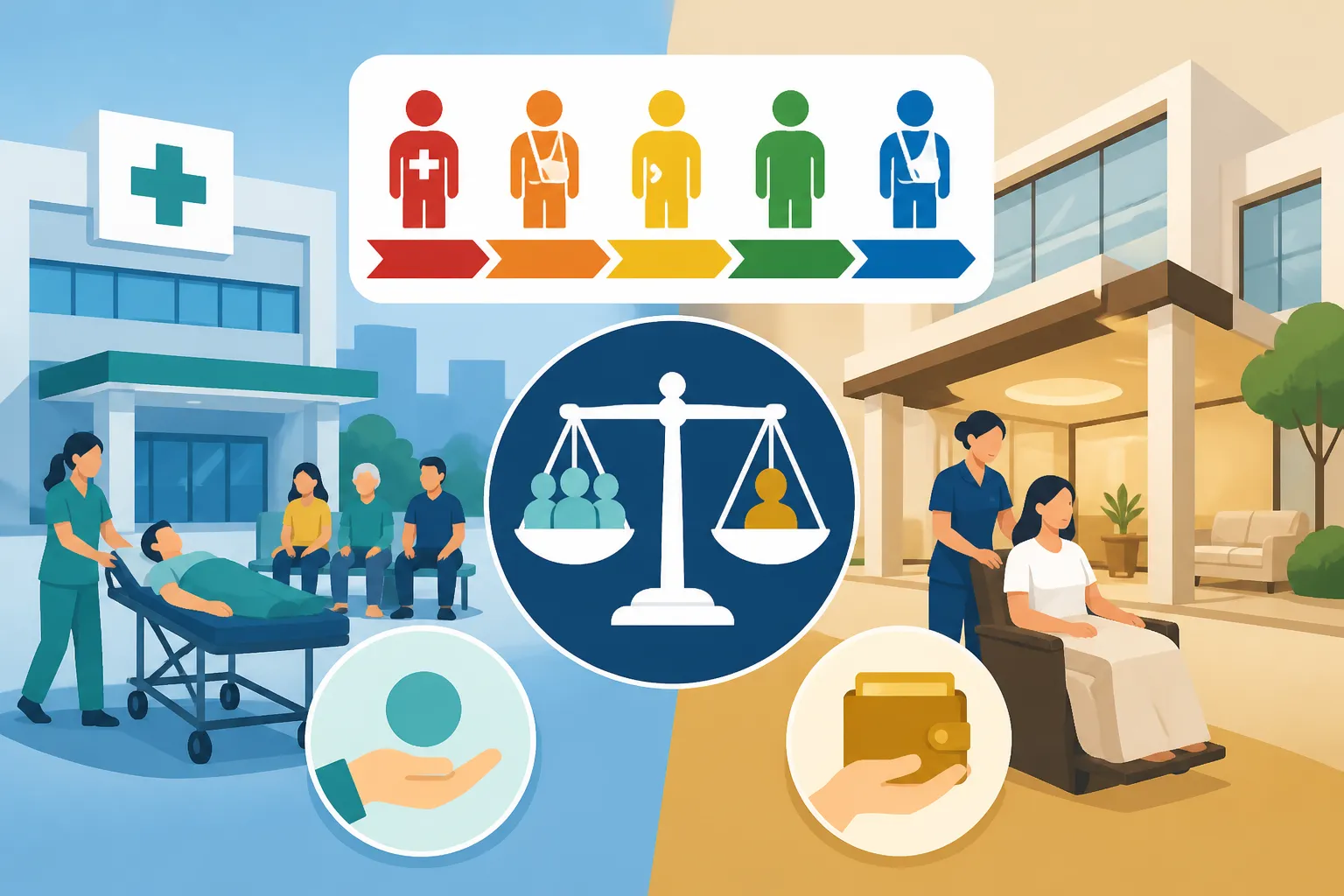
When you walk into any A&E in Singapore, you aren't seen on a first-come, first-served basis. This is perhaps the most significant culture shock for expats who expect their private insurance to buy them a front-row seat. Instead, every patient undergoes an immediate assessment by a triage nurse who assigns a priority level. This system is designed to save lives, meaning a person with a suspected heart attack will always leapfrog over someone with a deep laceration or a high fever.
The P1 to P4 Priority Levels
The Singaporean triage system typically breaks down into four main categories, though the exact terminology might shift slightly between public and private institutions. P1 (Priority 1) is reserved for life-threatening emergencies where every second counts. This includes cardiac arrest, major trauma, or severe respiratory distress. If you arrive in this state, you won't even see the waiting room; you’ll be whisked straight into the resuscitation bay. Although it looks chaotic, the efficiency is world-class.
P2 (Priority 2) covers major emergencies that are not immediately life-threatening but require urgent attention. Think of things like stable chest pain, severe abdominal pain, or a suspected broken limb. You will be seen quickly, but you might still wait 15 to 30 minutes if the P1 bays are full. P3 (Priority 3) is where most expats find themselves—minor emergencies like high fevers, persistent vomiting, or sprains. This is where the wait times begin to stretch, sometimes into the four-to-six-hour range at public hospitals. Finally, P4 (Priority 4) is for non-emergencies. If you show up with a cough that you’ve had for three days just because you want a quick check-up, you will be deprioritized, and in some cases, the staff might even suggest you visit one of the 24-Hour Clinics in Singapore: After-Hours Medical Care Guide instead.
Public Hospital Wait Times The Reality of the Triage Wall
At massive public institutions like SGH or Tan Tock Seng, the P3 wait can be brutal. It is not uncommon to see a waiting room packed with people at 3 AM. The triage system is blind to your nationality or your employment pass status; it only sees the severity of your condition. This is why many foreigners find the experience frustrating. You might be sitting there in significant pain, but because someone else arrived with a more critical physiological marker, they go ahead of you.
I’ve learned that the "Triage Wall" is a test of patience. The nurses are incredibly skilled at monitoring the room, and if your condition worsens while you wait, you should immediately inform them so they can re-triage you. However, if you are looking for a faster experience for a non-life-threatening issue, you should understand that the public system is built for the masses. For more on how this fits into the broader picture, check out our Singapore Healthcare System for Expats: Complete 2027 Guide.
The Role of the Triage Nurse
The triage nurse is the gatekeeper of the emergency room. Their job is to take your vitals—blood pressure, heart rate, temperature, and oxygen saturation—and ask a series of pointed questions about your symptoms. They are looking for "red flags" that might indicate a deeper issue. It is vital to be honest and specific during this interview. Don’t downplay your symptoms out of politeness, but don’t exaggerate them either, as these professionals have seen it all.
In a private A&E, the triage process is often much faster simply because the patient volume is lower. However, the logic remains the same. Even at a premium facility, a life-threatening case will take precedence over a minor injury. Understanding this helps manage expectations and reduces the "wait-time anxiety" that so many expats feel during their first emergency visit. Knowing What Documents Do You Need to Bring to the A&E in Singapore? before you arrive can also speed up the registration part of this process.
Public vs Private Choosing Your Battlefield
In Singapore, you have two distinct paths when an emergency strikes: the public restructured hospitals or the private medical centers. Choosing between them usually boils down to a trade-off between cost and speed, though the quality of medical care is exceptionally high in both sectors. If you are dealing with a catastrophic, multi-organ trauma, the public system is often the safest bet because they have the largest specialized teams on-site 24/7. However, for most expat-level emergencies, the private sector is the go-to for comfort and efficiency.
Public General Hospitals SGH, NUH, and KTPH
Public hospitals like the Singapore General Hospital (SGH) or the National University Hospital (NUH) are the backbone of the country’s medical infrastructure. For an expat, visiting these centers can be an overwhelming experience. They are massive, bustling, and often feel a bit utilitarian. However, they are world-renowned for their research and specialized care. If you have a complex condition, you will likely find the most experienced consultants at Singapore General Hospital (SGH) and Public Hospital Access for Expats.
The downside of the public A&E is the sheer volume of patients. Because the fees are subsidized for citizens, these hospitals are the first choice for the majority of the population. As a foreigner, you will pay the non-subsidized rate, which is higher than what a local pays but still generally lower than a private hospital’s base fee. However, the waiting environment is less comfortable, and you may find yourself sitting on a plastic chair for several hours before seeing a doctor. This is an important consideration when Finding Medical Care: Hospitals, Polyclinics, and GP Networks in a rush.
Premium Private A&E Units Mount Elizabeth and Gleneagles
If your budget or insurance allows, private A&E departments offer a completely different experience. Hospitals like Mount Elizabeth (both the Orchard and Novena locations) or Gleneagles feel more like high-end hotels than medical facilities. The waiting rooms are quiet, the staff-to-patient ratio is much higher, and you will typically see a doctor within 30 to 60 minutes for a P3 case. For many expats, this speed and the personalized attention are worth the premium price tag.
Private A&Es are excellent for situations where you want immediate diagnostic imaging (like an MRI or CT scan) without the long bureaucratic tail of a public hospital. In a private setting, the consultant on duty often has more time to sit with you and explain the findings in detail. If you are leaning toward this route, it's worth reading about Mount Elizabeth, Gleneagles, and Raffles: Premium Private Hospitals to see which location is closest to your home.
When the Public System is Actually Better
It might surprise you, but there are times when I would recommend a public hospital over a private one, even for those with premium insurance. In cases of major accidents, severe burns, or complex neurosurgical emergencies, the public restructured hospitals often have better "depth" in their emergency teams. Private hospitals are excellent for general emergencies and surgeries, but for rare, life-critical interventions, the public system’s sheer scale means they have specialists on-site that a private hospital might have to "call in" from their off-site clinics.
Furthermore, if you are concerned about long-term costs and your insurance has a low cap, public hospitals offer a more predictable billing structure. You won't have the "concierge" feel, but you will receive gold-standard medical treatment. Deciding which to use is a core part of Expat Health Insurance in Singapore: Public vs Private Coverage planning.
The Financial Blow Navigating A&E Costs and Payment
The biggest shock for most newcomers isn't the triage—it’s the bill. Singapore's healthcare is not free, and for foreigners, the costs can escalate quickly, especially if the A&E visit leads to an overnight stay for observation. Understanding the difference between how public and private hospitals charge is crucial for your financial peace of mind.
Flat Rates vs Itemized Billing
Most public hospital A&E departments charge a "flat fee" for the initial consultation and basic treatment. As of 2026, this fee for non-residents typically ranges from S$150 to S$200. This usually covers the doctor's consultation, basic nursing care, and standard medications administered in the A&E. However, this does not include specialized tests like X-rays, blood panels, or more advanced scans, which will be added to your bill as separate line items.
In contrast, private hospitals often have a lower "base" consultation fee but are much more aggressive with itemized billing. You might be charged for every swab, every tablet of Panadol, and every minute of nursing observation. It is very common for a "simple" visit to a private A&E for something like a deep cut to end up costing S$800 to S$1,200 once you factor in the doctor’s fee, the procedure fee, the equipment used, and the facility charges. This is why Healthcare Budgeting in Singapore: Managing Out-of-Pocket Costs is a frequent topic of conversation in expat circles.
| Cost Component | Public Hospital (Non-Resident) | Private Hospital |
|---|---|---|
| Initial Consultation Fee | S$150 – S$200 (approximate) | S$100 – S$350 (varies by time) |
| Diagnostic Imaging (X-Ray) | S$80 – S$150 | S$150 – S$400 |
| Basic Blood Tests | S$100 – S$250 | S$300 – S$600 |
| Total Typical P3 Visit | S$350 – S$600 | S$800 – S$2,000+ |
Insurance Handling SafetyWing and Cigna Global
How you pay for these visits depends heavily on your insurance provider. If you are a digital nomad or a frequent traveler, a plan like SafetyWing is often a lifesaver for unexpected accidents. They typically operate on a reimbursement basis for A&E visits, meaning you pay the hospital upfront and then submit your receipts via their app. It’s a straightforward way to handle the "smaller" emergency bills without a lot of paperwork at the hospital desk.
On the other hand, if you are a long-term expat with a comprehensive plan from Cigna Global, you might have access to direct billing for A&E visits, though this is more common for inpatient admissions. Cigna Global is designed for those who want high-limit coverage that spans across both public and private sectors. With a premium plan, you can often show your card at a private A&E, and the hospital will coordinate with the insurer. However, always check if you have a deductible or co-pay, as Does Insurance Cover A&E Visits If It’s Not a Life-Threatening Emergency? can be a gray area for some providers.
The Deposit Requirement
One thing that catches expats off guard is the "Admission Deposit." If the A&E doctor decides you need to stay in the hospital for further tests or surgery, the hospital will require a significant deposit before you are moved to a ward. At a public hospital, this might be S$2,000 to S$5,000 for foreigners. At a private hospital, it can easily be S$10,000 or more.
If you have a Letter of Guarantee (LOG) from an insurer like Cigna Global, the hospital may waive this deposit. However, if you are using a travel-style plan like SafetyWing, you should be prepared to put that deposit on your credit card. Always ensure your credit limits are high enough to handle a sudden five-figure medical charge. This is a critical step in Emergency Medical Care in Singapore: Ambulances and A&E Wards readiness.
Essential Logistics Documentation and Transport
In the heat of the moment, it’s easy to forget the basics. However, Singaporean hospitals are highly administrative, and having your ducks in a row can significantly reduce your stress levels once you arrive at the registration counter.
What to Bring to the A&E
First and foremost, you need your identification. For expats, this is your physical FIN card (Employment Pass, S Pass, or Dependant's Pass) or your passport. If you don't have these, the registration process becomes much more complicated. I keep a "hospital folder" in my kitchen drawer that contains photocopies of our FIN cards, our insurance policy numbers, and a list of all current medications and allergies for every family member.
Additionally, bring your mobile phone and a charger. You might be in the waiting room for a long time, and your phone will be your primary way to update your family or your employer. If you have a primary care physician, bring their contact details as well. The A&E doctors often like to follow up with your regular GP to ensure continuity of care. This is especially helpful if you’ve already been Choosing a Primary Care Physician (GP) in Singapore and have a medical history on file.
Calling an Ambulance vs Private Transport
One of the most important things to know is that dialing 995 connects you to the SCDF (Singapore Civil Defence Force) emergency ambulance service. This service is intended for life-threatening emergencies only. If you call 995 for a non-critical issue, you may be charged a significant fee, and the ambulance will only take you to the nearest public hospital—you cannot choose your destination. You can read more about this in our guide on Emergency Numbers: Calling 995 for Ambulance and 999 for Police.
If you want to go to a specific private hospital, you should call a private ambulance service or take a taxi/Grab if it is safe to do so. Private ambulances are much more expensive, but they offer the flexibility of choosing your facility. For many expats living in the central area, a Grab is often faster than waiting for an ambulance if the patient is stable enough to sit in a car. Understand the nuances of Ambulance Fees: When Is a Ride Free and When Do You Pay? before you make that call.
The Discharge Process and Follow-Up
Once you are treated and ready to leave the A&E, the discharge process begins. This involves a final review by the doctor, the collection of any prescribed medications from the hospital pharmacy, and the settlement of the bill. Make sure you request a "Memorandum" or a "Medical Report" if you plan to claim from insurance later. Most insurers require a doctor’s note explaining why the visit was medically necessary.
Don't forget to ask for a Medical Certificate (MC) if you need to take time off work. Singaporean employers are very strict about seeing an official MC from a registered doctor. Also, if the A&E doctor recommends a follow-up with a specialist, ask if they can provide a referral. While you can often book private specialists directly, having a referral can sometimes help with insurance claims. This is part of the logic behind Specialist Referrals: Do You Need a GP Before Seeing an Expert?.
Specialist Referrals and Admission from the A&E
Sometimes an A&E visit is just the beginning. If your condition is serious, you might be admitted to the hospital. This transition can be seamless in Singapore, but it requires some decision-making regarding your ward type and the specialists involved in your care.
Transitioning to Inpatient Care
When the A&E doctor determines that you need to be admitted, they will consult with a specialist on call. In the public system, you will be assigned a specialist based on the hospital’s rotation. In a private hospital, if you already have a preferred consultant, you can request that they be informed of your admission. This is where having a relationship with local doctors pays off.
The ward you are admitted to will also affect your bill. Public hospitals have different classes (A, B1, B2, C). As an expat, you will generally be placed in Class A (single room) or B1 (4-bed room) because you are paying non-subsidized rates. Private hospitals only offer "A-class" style rooms or better, including luxury suites. Your choice of ward should align with your insurance coverage, which is a key part of Understanding Corporate Health Insurance vs Personal Medical Plans.
Managing Follow-up Appointments
After an A&E visit, you are often given a follow-up appointment at the hospital’s Specialist Outpatient Clinic (SOC). These appointments are vital for ensuring that you are recovering correctly. However, keep in mind that SOC appointments in public hospitals can have long wait times—sometimes weeks or months for non-urgent issues.
If you have a plan with a brand like Cigna Global, you might find it more efficient to take your A&E discharge summary to a private specialist for follow-up care. This allows you to choose your doctor and get an appointment much faster. If you need to find a specific expert, we have a guide on Finding English-Speaking and Internationally Trained Doctors to help narrow down your search.
Emergency Medical Care in Singapore Disclaimer
The information provided in this guide is for educational and informational purposes only and does not constitute professional medical or legal advice. While we strive to keep the details accurate and up to date for 2026, healthcare policies, triage protocols, and pricing in Singapore are subject to change by the Ministry of Health and individual hospital managements. Always prioritize immediate medical attention in an emergency by calling 995 or proceeding to the nearest A&E department. Consult with your insurance provider to understand the specifics of your coverage and any potential out-of-pocket costs. The author and publisher are not liable for any actions taken based on the information provided in this article.