Is Calling an Ambulance in Singapore Fast? Expected Response Times
Imagine waking up at 3 AM with crushing chest pain in a high-rise condo, staring at your phone and realizing you do not actually know the local emergency number. I’ll never forget the sheer panic I felt during my first year here when my toddler had a high fever seizure and I realized I was completely unprepared for a medical crisis. This guide explains exactly how fast Singapore's ambulances respond, the crucial difference between the two emergency numbers, and what you will realistically pay for the service.
Real-World Ambulance Response Times in Singapore
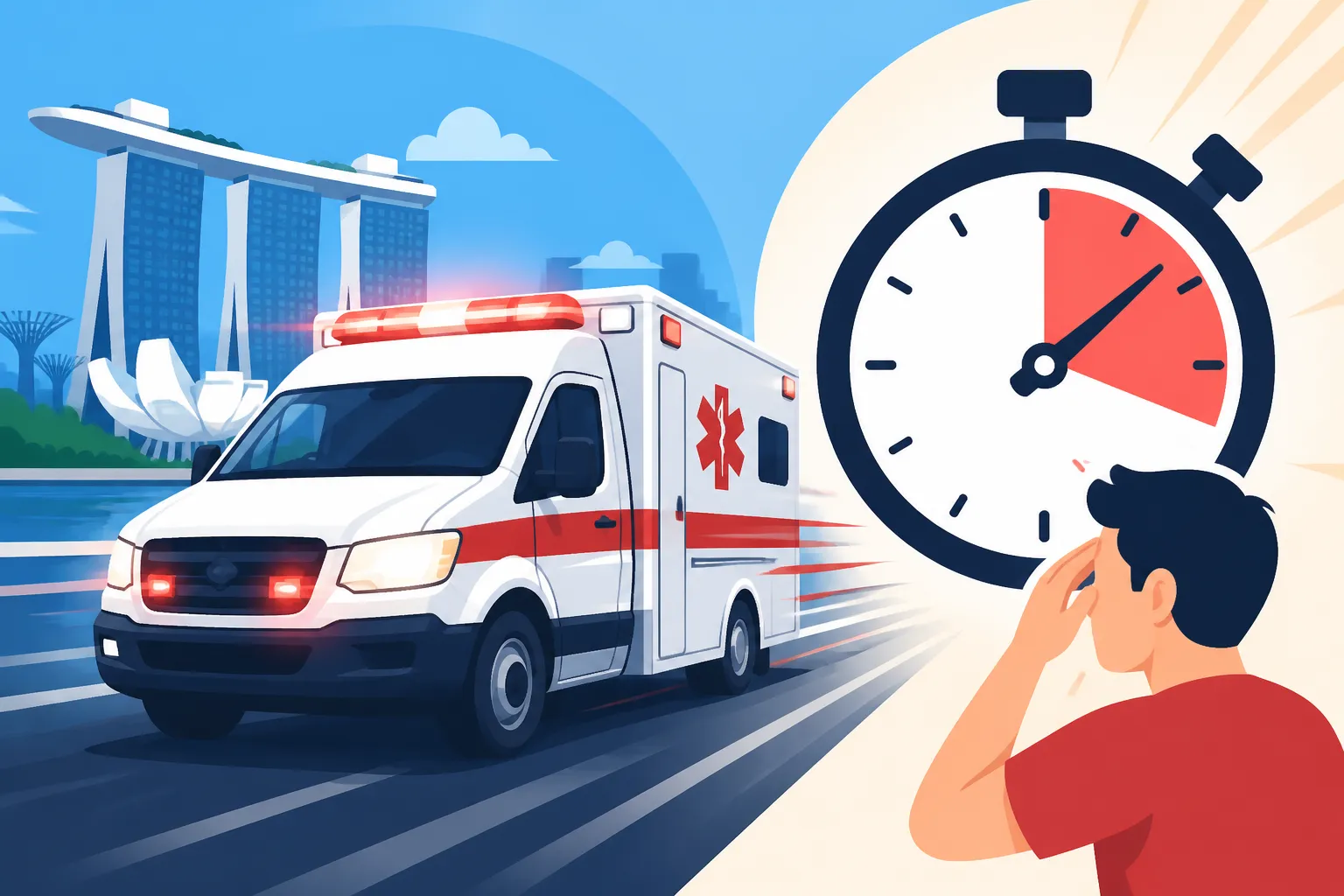
When you are in the middle of a medical crisis, every second feels like an hour. In Singapore, the gold standard for emergency medical services is managed by the Singapore Civil Defence Force (SCDF). For years, the SCDF has maintained a target of responding to life-threatening emergencies within 8 to 11 minutes. In my experience, and based on recent performance data, they hit this target for the vast majority of cases, often arriving much faster in urban centers like Orchard or the CBD.
However, "fast" is a relative term that depends heavily on your specific location and the time of day. If you are living in a more secluded area like certain parts of Bukit Timah or the far reaches of Tuas, the response might lean toward the longer end of that spectrum. Singapore’s urban density is both a blessing and a curse; while there are many fire stations and medical outposts, the traffic during a tropical downpour can bring the city to a standstill.
It is also important to understand the concept of "Tiered Response." The SCDF uses a sophisticated dispatch system that prioritizes cases. If you call with a life-threatening condition like cardiac arrest or a major stroke, you are categorized as a "Priority 1" case. In these instances, the SCDF might even dispatch a Fire Medical Vehicle or a rapid-response motorcycle alongside the ambulance to ensure medical intervention starts the moment they arrive, even if the larger ambulance is still weaving through traffic. This is a core part of Emergency Medical Care in Singapore: Ambulances and A&E Wards that often surprises newcomers who expect just a single van to show up.
Understanding the Difference Between 995 and 1777
One of the biggest mistakes expats make is not knowing which number to dial. In Singapore, there are two distinct services that handle medical transport, and using the wrong one can lead to unnecessary delays or unexpected bills. You must memorize these numbers and keep them on your fridge or saved in your phone’s favorites.
The number 995 is strictly for life-threatening emergencies. This connects you to the SCDF emergency dispatch. If someone is unconscious, having severe difficulty breathing, or has suffered a major trauma, this is the number you call. The operators are highly trained and will stay on the line with you to provide instructions while the ambulance is en route. For more details on the logistics of these calls, see our guide on Emergency Numbers: Calling 995 for Ambulance and 999 for Police.
The number 1777, on the other hand, is for non-emergency medical transport. This is a centralized number that coordinates private ambulance operators. You should use this number if you need to transport a bedridden relative to a scheduled appointment, or if you have a stable medical condition that requires a stretcher but doesn't require "lights and sirens" speed. Using 995 for a non-emergency—like a mild fever or a sprained ankle—is highly discouraged and can actually result in a fine, as it diverts life-saving resources away from those in dire need. This distinction is a major part of Non-Emergency Medical Transport: When to Use 1777 Instead of 995 which every resident should understand.
The Triage System and Why You Cannot Choose Your Hospital
This is the part that usually frustrates expats the most. If you call 995, the SCDF ambulance will take you to the nearest "appropriate" public hospital. They operate on a strict geographical and capability-based protocol. Even if your private doctor is at Mount Elizabeth or Gleneagles, an SCDF ambulance will generally not take you there. Their mission is to stabilize you at the closest facility equipped to handle your specific emergency.
For many of us who carry comprehensive insurance through providers like SafetyWing or Cigna Global, the desire is often to head straight to a private facility where we might have a preferred specialist. However, in a true emergency, the SCDF paramedics have the final say. They are looking at the "nearest available" emergency department to ensure the fastest possible transition from the ambulance to a trauma bay. If you are stable and insist on a private hospital, you will likely need to engage a private ambulance via 1777, but be aware that private ambulances do not have the same legal authority to bypass traffic lights or use bus lanes that the SCDF possesses.
Once you arrive at the public hospital, you will go through a process known as triage. This isn't first-come, first-served. It is based on clinical urgency. If you arrive by ambulance with a non-life-threatening issue, you might find yourself waiting several hours while the doctors attend to "walk-in" patients who have more critical needs. Understanding how A&E Departments: Triage Systems and Payment at Public vs Private Hospitals work can help manage your expectations during those stressful hours in the waiting room.
Ambulance Costs and Fees for Foreigners
A common myth in the expat community is that emergency ambulances are free for everyone. While it is true that the SCDF does not charge for "genuine" emergencies, there is a catch for non-emergency use of the 995 system. If the hospital medical staff determines that your case was not an emergency, you will be issued a bill for the SCDF ambulance service, which typically starts around S$274 (and is subject to change with GST).
For private ambulances (1777), the costs are entirely out-of-pocket and vary by operator. You can expect to pay anywhere from S$150 to S$500 depending on the time of day, the distance traveled, and whether or not you require oxygen or specialized medical equipment during the journey. This is where having a robust health plan from Cigna Global becomes incredibly valuable, as these "ancillary" costs can add up quickly if you require multiple transfers.
| Service Type | Phone Number | Estimated Cost | Best For |
|---|---|---|---|
| SCDF Emergency | 995 | Free (if genuine emergency) | Unconsciousness, stroke, heavy bleeding |
| SCDF Non-Emergency | 995 | S$274+ | Misuse of the emergency line |
| Private Ambulance | 1777 | S$150 – S$500 | Hospital transfers, stable patients |
| Private A&E Transport | Direct Clinic | Variable | Direct transport to private hospitals |
It is also worth noting that for foreigners, the cost of the emergency room visit itself will be at the "unsubsidized" rate. Even if the ambulance ride was free, the subsequent treatment, scans, and consultation at a public hospital like SGH or NUH will be billed at full price. For more on the financial side, refer to Ambulance Fees: When Is a Ride Free and When Do You Pay? to avoid any "bill shock" after the adrenaline wears off.
Insurance Coverage for Emergency Transport
Because ambulance fees and emergency room visits can be expensive, most veterans here suggest maintaining a private health policy regardless of what your employer provides. Standard company insurance often has "inner limits" on ambulance transport that might only cover a few hundred dollars. If you are an active traveler or a digital nomad based in Singapore, a plan from SafetyWing can provide that extra layer of security for unexpected accidents.
When choosing a policy, look specifically for "Emergency Medical Evacuation and Transport" clauses. Some premium plans from Cigna Global even cover the cost of a private ambulance to a private hospital, provided the patient is stable enough for the transfer. If your current coverage is lacking, you may want to investigate Expat Health Insurance in Singapore: Public vs Private Coverage to ensure you aren't left with a massive bill during a medical crisis.
What to Expect During the Emergency Call
When you dial 995, the operator will ask several specific questions. Being prepared for these can actually shave minutes off the response time. They will ask for your location (including the postal code and unit number), a brief description of what happened, and whether the patient is conscious and breathing.
If you are a non-native English speaker, the stress of the situation can make communication difficult. Singapore's emergency operators are used to various accents, but it helps to speak slowly and clearly. We have put together a guide on What to Say When Calling 995: Scripts for Non-Native English Speakers that you can print out and keep near your phone. It includes common phrases and the specific medical vocabulary used by local dispatchers.
One unique aspect of the Singapore system is the "myResponder" app. This is a government initiative that alerts nearby "Community First Responders" (volunteers trained in CPR and AED use) to cardiac arrest cases in their vicinity. If you call 995 for a heart attack, don't be surprised if a neighbor or a passerby arrives with an AED before the ambulance does. This community-driven approach is one reason why Singapore's survival rates for out-of-hospital cardiac arrests have been improving.
Preparing Your Household for a Medical Emergency
Speed isn't just about the ambulance; it’s about your readiness. In the chaos of an emergency, searching for a passport or an insurance card can waste precious time. We recommend having an "Emergency Folder" near the front door. This should contain copies of everyone's passport, FIN card, and insurance policy details.
You should also keep a list of current medications and any known allergies. When the paramedics arrive, they will ask for this immediately. Having it ready allows them to begin treatment safely and provides the hospital doctors with critical information the moment you arrive. For a full list of what to have on hand, check What Documents Do You Need to Bring to the A&E in Singapore?.
Furthermore, make sure your domestic helper or any visiting relatives know the 995 and 1777 numbers. Many helpers come from countries where the emergency number is different (like 911 or 999), and in a panic, they may revert to what they know. A simple "In Case of Emergency" poster in the kitchen can be a lifesaver.
Navigating Private Hospital Emergency Rooms
If the situation is not life-threatening but requires immediate attention—such as a deep cut that needs stitches or a suspected broken bone—you might choose to take a taxi or a private hire car (Grab/Gojek) directly to a private hospital A&E. Facilities like Mount Elizabeth Novena or Raffles Hospital often have shorter waiting times than public hospitals, though the costs will be significantly higher.
In these cases, the "response time" is entirely dependent on how fast your Grab driver can get there. Taxis are generally very reliable in Singapore, but during peak hours or heavy rain, they can be scarce. If you have a car, knowing the fastest route to the nearest A&E is essential. However, if there is any doubt about the patient’s stability, never attempt to drive them yourself; always call 995. The paramedics can provide life-saving interventions in the back of the ambulance that a Grab driver simply cannot.
Managing your health as an expat requires a proactive approach. From knowing the right numbers to ensuring your insurance from SafetyWing or Cigna Global is up to date, being prepared is the best way to handle the high-pressure environment of a medical emergency in the Lion City.
Medical Disclaimer
This article is for informational purposes only and does not constitute professional medical advice, diagnosis, or treatment. Always seek the advice of your physician or other qualified health provider with any questions you may have regarding a medical condition. Never disregard professional medical advice or delay in seeking it because of something you have read in this guide. In a life-threatening emergency, dial 995 immediately.