Ambulance Fees: When Is a Ride Free and When Do You Pay?
One of the most terrifying moments of expat life is staring at a medical emergency and not knowing which three-digit number to dial or how much it will cost. I remember the paralyzing hesitation when my neighbor collapsed—I didn't want to call the wrong service and end up with a massive bill or, worse, a delayed response. This guide clarifies the critical distinctions between Singapore’s free emergency ambulances and paid private transport to ensure you make the right call.
The Divided World of Singapore Medical Transport
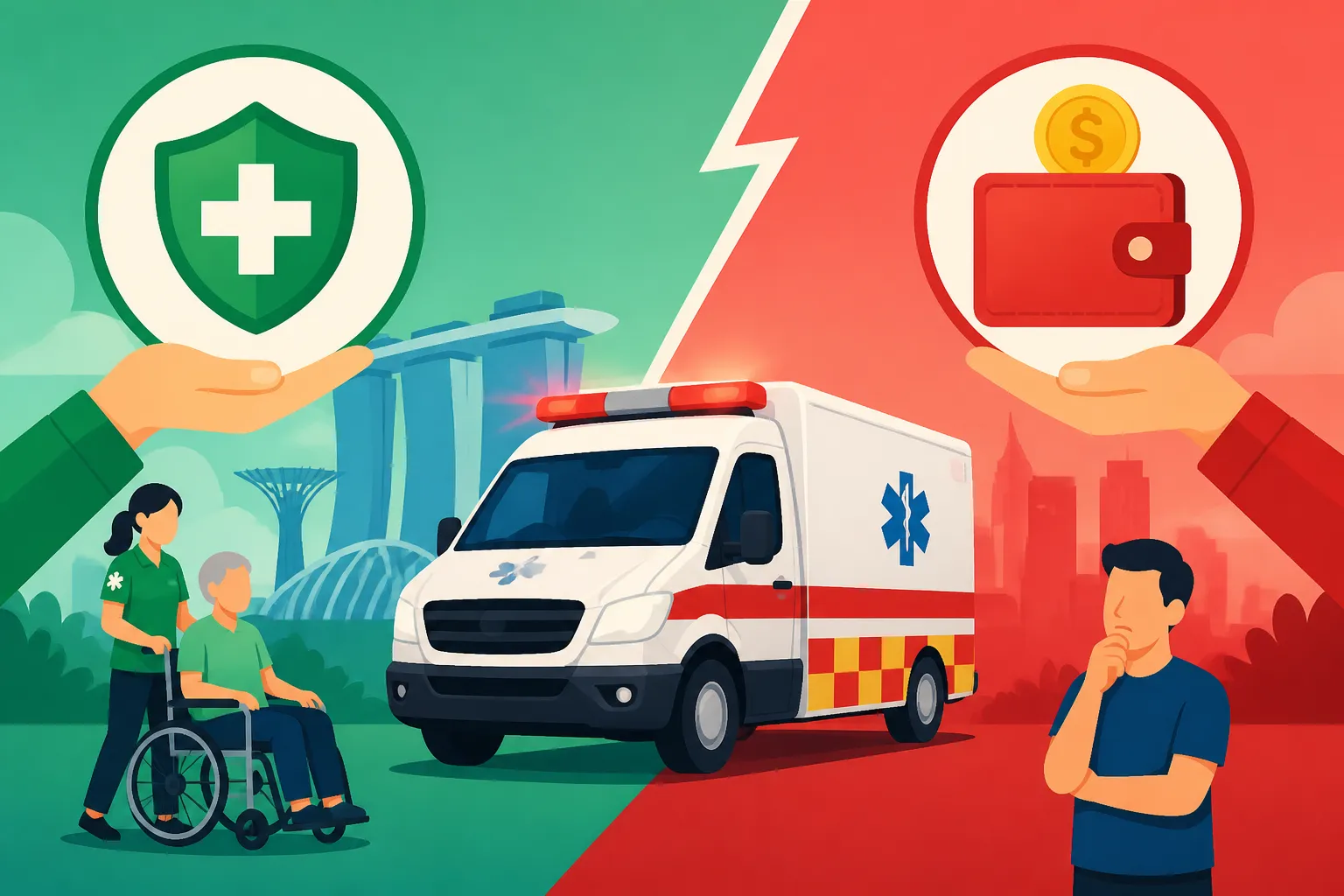
Singapore operates a two-tier ambulance system that can be confusing for those of us used to single-service systems back home. The first tier is the Singapore Civil Defence Force (SCDF), which manages the 995 emergency line. This is the service you see with red and white vehicles, designed for life-and-death situations. The second tier consists of private ambulance operators who handle non-emergency transfers, hospital-to-hospital movements, and elective transport to private medical facilities.
Understanding the difference is not just about logistics; it is about the ultimate destination of the patient. If you call the emergency line, the SCDF has a strict policy of transporting patients to the nearest designated public government hospital. You cannot request a specific doctor or a private facility like Gleneagles or Mount Elizabeth Novena. This is a common point of frustration for expats who have comprehensive private insurance and want to see their regular specialists. If your condition is stable enough that you insist on a specific private hospital, you must step outside the public emergency system and engage a private provider.
Navigating this system is a core part of the Singapore Healthcare System for Expats: Complete 2027 Guide because the choices you make in those first few minutes dictate your entire treatment path. For those who are new to the island, the 995 system is incredibly efficient, but it is a "no-choice" system. You are entering the public healthcare stream immediately upon boarding that vehicle. If you are looking for more flexibility, you will need to look into Non-Emergency Medical Transport: When to Use 1777 Instead of 995 to understand the alternative providers who operate outside the SCDF umbrella.
The Role of SCDF 995 Services
The SCDF is the backbone of emergency medical services in Singapore. Their primary mission is to respond to life-threatening situations where every second counts. Because their resources are limited, the government has implemented strict protocols to prevent the misuse of emergency vehicles. When you dial 995, a trained dispatcher will put you through a rigorous triage process over the phone to determine if your situation warrants an emergency dispatch.
If the SCDF determines that the case is a genuine emergency, the ambulance ride is free for everyone—citizens, Permanent Residents, and foreigners alike. This is a unique feature of the Singapore system designed to ensure that nobody hesitates to seek help during a heart attack or major accident due to cost. However, the catch is that you will be taken to a public hospital A&E department. To understand how these departments function once you arrive, you should review A&E Departments: Triage Systems and Payment at Public vs Private Hospitals.
The Private Ambulance Alternative
Private ambulances are the go-to solution for any medical transport that doesn't fit the "life-or-death" criteria. These companies, such as EMS Singapore or Hope Ambulance, are fully equipped but operate as commercial entities. They are the only ones who will agree to pick you up from your condo and drive you directly to a private hospital of your choice. This is particularly relevant for expats who prefer the amenities and shorter wait times of Mount Elizabeth, Gleneagles, and Raffles: Premium Private Hospitals.
While these services are highly professional, they are not part of the national emergency dispatch system. You must call their individual hotlines or use a consolidated non-emergency number. Because these are private businesses, you will be charged a fee regardless of the severity of the medical condition. These fees can escalate quickly depending on whether the patient requires oxygen, a nurse escort, or advanced life support equipment during the transit.
When the Ride is Free and When You Pay
The financial aspect of ambulance services in Singapore is governed by the "Emergency" versus "Non-Emergency" classification. This is not a subjective decision made by the patient; it is an objective assessment made by the SCDF paramedics on the scene or the triage staff at the hospital. This distinction is the number one cause of "bill shock" for expats who call 995 for what turns out to be a minor injury or a standard illness.
In recent years, the SCDF has become much stricter about charging for non-emergency calls to discourage the public from using 995 as a "taxi to the hospital." If your condition is deemed non-emergency, you will be issued a bill, typically around S$274 or more, depending on the current government rates. This fee is meant to cover the operational costs of the vehicle and personnel that could have been used for a more critical case.
Defining a Genuine Emergency
What exactly constitutes an emergency in the eyes of the Singapore government? Generally, it includes conditions where there is an immediate threat to life or limb. This includes cardiac arrest, unconsciousness, severe chest pain, major trauma (such as a fall from height or a serious traffic accident), uncontrollable bleeding, and suspected strokes. If you call 995 for these reasons, the service remains free of charge as part of the public safety net.
However, if you call 995 for a persistent cough, a mild fever, or a small localized skin rash, the paramedics will still attend to you, but they will likely categorize the trip as non-emergency. This is why it is essential to have a backup plan, such as knowing the location of your nearest 24-Hour Clinics in Singapore: After-Hours Medical Care Guide, which can handle urgent but non-life-threatening issues without involving the emergency dispatch system.
Understanding the Non-Emergency Fee
If you are hit with the non-emergency fee from the SCDF, it is usually added to your final hospital bill or sent as a separate invoice from the SCDF. This fee is non-subsidized for foreigners and is rarely negotiable. It is important to realize that even if you feel your situation was an emergency, the final say lies with the medical professionals.
Many expats find that their Expat Health Insurance in Singapore: Public vs Private Coverage will cover these costs, but only if the A&E admission was justified. Some lower-tier or travel-oriented plans might exclude ambulance fees if the patient was not hospitalized for at least 24 hours. This is a nuance often found in the fine print of policies provided by companies like SafetyWing, which are excellent for emergencies but require careful reading regarding "ambulance-only" claims without subsequent admission.
Costs of Private Ambulance Services
When you opt for a private ambulance, the pricing structure is entirely different. You are paying for a service, and that service has a base rate, a mileage rate, and often surcharges for "after-hours" or "public holiday" pick-ups. On average, a standard private ambulance transfer within Singapore will cost between S$150 and S$250.
If the patient requires more than just a stretcher—for instance, if they need to be on a ventilator or require a doctor to be present in the vehicle—the costs can easily exceed S$800. These costs are almost always "out-of-pocket" initially, and you will need to seek reimbursement from your provider. Comprehensive plans from Cigna Global are typically very robust in this area, often allowing for direct billing or easy claims for private ambulance transfers if they are medically necessary for a hospital admission.
| Service Type | Provider | Cost for Foreigners | Destination Choice |
|---|---|---|---|
| Emergency | SCDF (995) | Free (If Emergency) | Nearest Public Hospital |
| Non-Emergency | SCDF (995) | ~S$274+ | Nearest Public Hospital |
| Standard Transfer | Private (1777) | S$150 – S$250 | Any Hospital |
| Intensive Care | Private | S$800 – S$1,500+ | Any Hospital |
| After-Hours Surcharge | Private | S$50 – S$100 extra | N/A |
Navigating Insurance and Reimbursement
For many of us, the cost of the ambulance is less about the S$300 fee and more about the S$30,000 hospital bill that might follow. The ambulance you choose often determines the hospital you end up in, which in turn determines your insurance coverage. Most corporate insurance plans have specific limits on which hospitals you can visit. It is vital to Understanding Your Employer’s Medical Benefits Package Before Signing so you know if you are restricted to public wards or if you have the "premium" access required for private facilities.
Insurance providers generally divide ambulance coverage into two categories: "Emergency Transport" and "Inter-Hospital Transfer." Emergency transport is usually covered under the inpatient or A&E benefit of your policy. Inter-hospital transfers—for instance, if you are moved from a public hospital to a private one for a specialized surgery—may require prior authorization from your insurer to be fully covered.
Travel Insurance vs. International Health Insurance
If you are in Singapore on a Short-Term Visit Pass or a new Employment Pass, you might be relying on travel-style insurance. Providers like SafetyWing are specifically designed to catch the "big" emergencies. They are highly efficient at handling the costs of a 995 call that results in a major surgery or accident. However, they may not cover a private ambulance ride you called yourself because you didn't like the wait time at the public hospital.
On the other hand, long-term expats often choose modular international plans. A company like Cigna Global allows you to add specific "Outpatient" or "Vision and Dental" modules, but their core "International Medical" module almost always includes comprehensive ambulance coverage. These plans are designed for the person who wants to call a private ambulance to go to Raffles Hospital because they know the specialist there has their full medical history.
The Question of Pre-Existing Conditions
One trap that expats often fall into involves ambulance rides for pre-existing conditions. If you have a known heart condition and call an ambulance for chest pain, your insurer will look closely at whether that condition was declared and covered under your policy. If the condition is excluded, the ambulance ride—even if it was a life-saving 995 call—might be denied for reimbursement.
This is a significant part of Healthcare Budgeting in Singapore: Managing Out-of-Pocket Costs. You must always keep a small emergency fund specifically for these "unclaimable" medical expenses. Even if the SCDF ride was free, the subsequent tests in the A&E that lead to a "pre-existing condition" diagnosis could leave you with a bill that isn't covered by your primary insurance policy.
Does Insurance Cover A&E Visits If It’s Not a Life-Threatening Emergency?
This is the gray area where most disputes happen. Many insurers will only pay for the ambulance and the A&E facility fee if the patient is actually admitted to the hospital. If you go to the A&E via ambulance, get some fluids and a scan, and then get sent home three hours later, the insurer might classify this as "outpatient" care. If your policy only covers "inpatient" care, you could be responsible for the entire bill. You should check the specifics in Does Insurance Cover A&E Visits If It’s Not a Life-Threatening Emergency? to see how your specific plan might react to this scenario.
Step-by-Step Guide to Calling for Help
When a crisis hits, your brain often goes into "fight or flight" mode, and basic information can slip your mind. In Singapore, the way you communicate with the dispatcher can actually influence whether you are charged or not. Being clear, concise, and using the right terminology is essential for getting the appropriate level of care.
The dispatchers for 995 are highly trained, but they are following a strict script. They will ask you for your location first. In Singapore, giving the 6-digit postal code of your building is the fastest way for them to find you. This is much more effective than trying to explain "the green condo near the mall." Every building in Singapore has a unique postal code that points exactly to its location.
What to Say on the 995 Call
When you call 995, state the nature of the emergency immediately. Use keywords like "unconscious," "heavy bleeding," "chest pain," or "difficulty breathing." If the patient is a child or an elderly person, mention their age immediately. Do not minimize the symptoms. If you are unsure if it is an emergency, err on the side of caution and call 995, but be prepared for the possibility of a fee if the paramedics determine it is not critical.
While waiting for the ambulance, gather the patient's passport or FIN card (Employment Pass/Dependant's Pass) and any regular medications they take. Paramedics will need to see these to ensure they don't administer something that causes a reaction. If the patient has a known allergy or a chronic condition, having this written down can save lives.
When to Call a Private Provider Instead
If the patient is stable—for example, they have a broken leg but are not in shock, or they have a high fever but are alert—and you want to go to a specific private doctor, do not call 995. Instead, call a private ambulance service or even a "medical transport" Grab/taxi if the patient can sit upright.
Calling 1777 (the centralized private ambulance booking line) is the best move for these non-urgent scenarios. Be aware that 1777 is a dispatch coordinator for various private companies; you are still hiring a private firm and will be billed accordingly. This is the correct choice for anyone who wants to maintain control over which hospital they are admitted to and who has the insurance coverage (like a high-tier Cigna Global plan) to support private hospital fees.
Managing the Handover at the Hospital
Once the ambulance arrives at the hospital, the paramedics will hand the patient over to the triage nurses. If you arrived via SCDF, you will be categorized according to the Patient Acuity Category Scale (PACS). P1 cases (life-threatening) are seen immediately, while P3 cases (minor) can involve several hours of waiting.
If you are a family member following the ambulance, make sure you have the insurance details ready. Most public hospitals in Singapore will require a "Letter of Guarantee" (LOG) from your insurer or a credit card deposit before they proceed with non-emergency admission. Having your SafetyWing or other insurance portal login ready on your phone can significantly speed up the administrative side of the emergency.
Practical Tips for the First 30 Days
The best time to learn about ambulance fees is before you actually need one. Newcomers often find that the "Singapore way" of doing things is highly logical but very rigid. If you follow the rules, the system works perfectly. If you try to negotiate a 995 ambulance to go to a private hospital, you will only waste precious time and frustrate the first responders.
One of the most proactive things you can do is to program the local emergency numbers into your phone. But don't just add 995; add the numbers of the private ambulance providers near your home or the 24-hour hotline of your preferred private hospital. Many private hospitals have their own dedicated ambulance fleets that can be dispatched directly to their facilities.
Setting Up Your Medical Folder
Every expat household should have a "red folder" near the door. This folder should contain copies of your passports, FIN cards, insurance policy summaries, and a list of all current medications for every family member. In the heat of an emergency, finding these documents is the last thing you want to be doing.
This folder should also include your "choice" of hospital. If you have done your research and decided that your family's needs are best met by a specific facility, write that down along with the private ambulance number that can take you there. This ensures that if a helper or a guest is at home during an emergency, they know exactly who to call.
Understanding the 1777 Response Time
Unlike 995, which aims to reach you within 11 minutes for the vast majority of calls, private ambulances can have longer wait times. They are not authorized to use sirens and lights with the same frequency as SCDF vehicles unless they are transporting a critical patient under specific protocols.
If you choose the private route, ask the dispatcher for an estimated time of arrival (ETA). If the wait is too long and the patient's condition is deteriorating, do not hesitate to pivot and call 995. It is better to pay the S$274 non-emergency fee or end up in a public hospital than to wait 45 minutes for a private vehicle when a situation is turning critical.
The Cost of Peace of Mind
Ultimately, the ambulance system in Singapore is a reflection of the country itself: efficient, clearly defined, and strictly regulated. The "free" service is a public safety tool, while the paid service is a luxury or a matter of medical preference. By aligning your expectations with these two tiers, you can avoid unnecessary costs and ensure your family gets the care they need.
Whether you are relying on the high-end coverage of Cigna Global to access the best private wards or using a more flexible, accident-focused plan like SafetyWing, the key is knowing which number to call. Singapore is one of the safest places in the world to have a medical emergency, provided you know how the system operates.
Disclaimer
The information provided in this guide is for general informational purposes only and does not constitute medical or legal advice. While we strive to provide the most up-to-date facts regarding Singapore’s medical systems, policies and fees can change. Always verify current rates with the SCDF or your insurance provider. In a life-threatening emergency, always dial 995 immediately. We do not endorse any specific insurance provider or medical facility; your choice of care should be based on your personal needs and professional medical consultation.